EduFocal Wants to Become Walstron. The Numbers Say the Company Isn't There Yet.

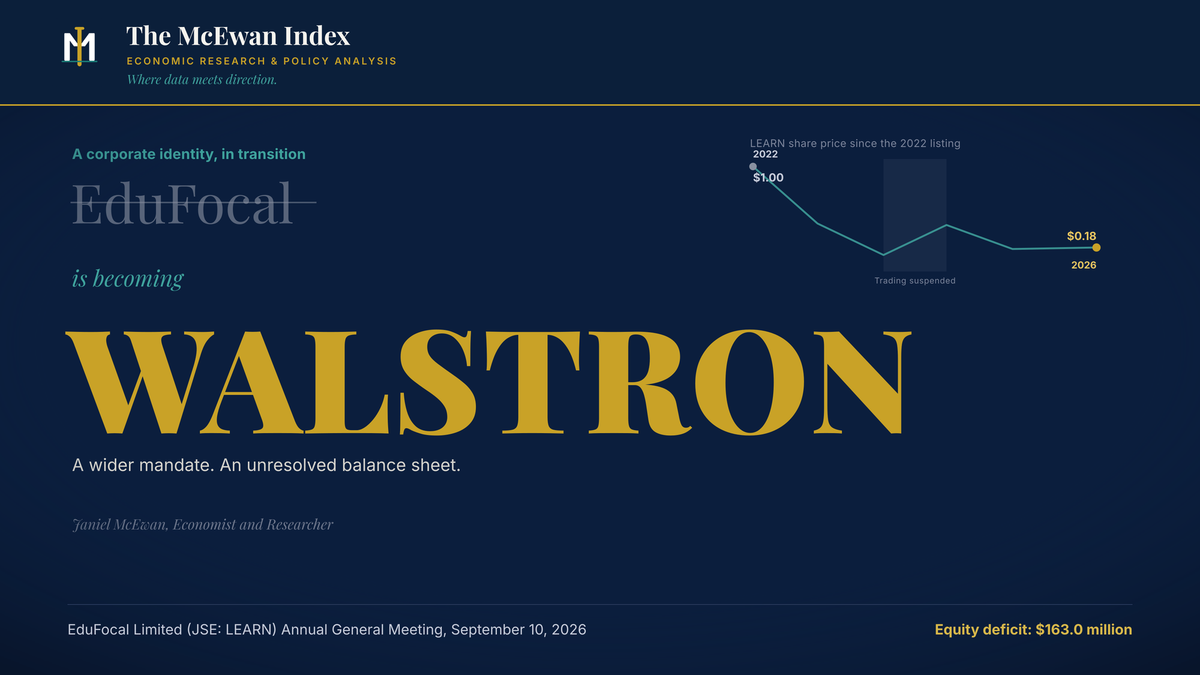
A Jamaican EdTech pioneer is asking shareholders to approve a new name, a wider mandate and open-ended share-issuance powers, all while its auditors flag material uncertainty about its ability to continue as a going concern.
By Janiel McEwan, Economist and Researcher
There is a particular kind of irony in a company built to teach children how to pass examinations asking its own shareholders, in September 2026, to approve a resolution that it cannot fully explain.
EduFocal Limited, the Kingston-based education technology firm that has spent fourteen years helping Jamaican students prepare for the Primary Exit Profile and CSEC examinations, held its Annual General Meeting on September 10, 2026. Shareholders were asked to vote on renaming the company Walstron Limited and widening its legal mandate to cover education technology, technology, commerce, and properties and real estate. They were also asked to hand the board broad, largely undefined authority to issue new shares to executives, advisers, partners and employees, at prices and in quantities the resolution itself does not specify.
None of this happens in a vacuum. It happens against a backdrop in which EduFocal's auditors have flagged material uncertainty about the company's ability to continue as a going concern, in which the group closed 2025 with a $163.02-million equity deficit and $104,315 in cash, and in which the company has been suspended from JSE trading twice in two years for failing to file audited accounts on time.
The AGM is not simply a housekeeping exercise of adopting financial statements, electing directors and reappointing auditors, although it is formally all of those things. It is a referendum on whether a company that has just spent eighteen months cutting its way back to operating profitability deserves the additional, largely unconstrained latitude it is now requesting. The central question shareholders, analysts and regulators should be asking is not whether EduFocal is changing. It plainly is. The question is whether what is being proposed amounts to a coherent reset of the business, or whether it simply widens the space in which an already financially constrained company can attempt more things at once.
The meeting, plainly stated
EduFocal Limited trades on the Jamaica Stock Exchange Junior Market under the ticker LEARN. It was founded in 2012 by Gordon Swaby and Paul Allen as a social learning platform aimed at students preparing for national examinations, and it listed on the Junior Market on March 15, 2022, its tenth anniversary, after an initial public offering of 129,689,219 ordinary shares at $1.00 each that was oversubscribed by roughly 230 per cent. The 2026 AGM addressed the financial year ended December 31, 2025, and combined the routine business of an annual meeting with two special resolutions that go to the heart of the company's identity and capital structure.
The routine business included adoption of the audited 2025 financial statements, the re-election of directors, the reappointment of Garcia Campbell & Associates as auditor, and approval of directors' fees. The special resolutions were the proposal to change the company's name to Walstron Limited and to widen its objects clause, and the authorisation for directors to allot unissued ordinary shares as compensation for services or in settlement of obligations, at the board's discretion.
Resolution by resolution: what shareholders were actually approving
Adopting the accounts is not endorsing every decision behind them
The adoption of audited financial statements is a standard AGM item, and in EduFocal's case it is anything but a formality. The 2025 accounts, prepared under IFRS and audited by Garcia Campbell & Associates, carry an unmodified opinion but include an explicit paragraph on material uncertainty related to going concern. That is a serious disclosure. It means the auditors believe there is a real possibility, not a remote one, that the company may be unable to continue operating without the successful execution of management's plans to raise capital, restructure liabilities and grow revenue.
Shareholders voting to adopt these statements are not thereby endorsing management's handling of the African expansion that had to be wound down, or the string of late filings that twice triggered trading suspensions. Adoption confirms that the accounts fairly present the company's financial position as audited; it does not retroactively bless the strategic decisions that produced that position. That distinction matters, because it is easy for a company under pressure to treat a routine adoption vote as broader validation than it actually is.
The board that inherited the crisis
EduFocal's board has been substantially rebuilt over the past eighteen months, largely out of necessity rather than design. Co-founder and long-serving Chief Technical Officer Paul Allen resigned as a director, as did director Grace Lindo and Lloyd Swaby, the CEO's father. Long-time chairman Peter Levy, an insurance executive who had held the role for twelve years, resigned in June 2025 to focus on the transformation of BCIC following its acquisition of JN General Insurance. Fintech professional Harry Campbell was appointed chairman effective September 2, 2025. Human resources specialists Olivia Cream and Mark Pike joined the board effective June 26, 2025, with Cream chairing a Remuneration Committee that the company says is now fully compliant with the JSE's revised Junior Market rules on independent composition. Chair of the Governance Committee Shauna Fuller Clarke subsequently resigned effective December 31, 2025.
At the 2026 AGM, Gordon Swaby retired by rotation and stood for re-election, alongside Mark Pike, Olivia Cream and Harry Campbell, whose appointments since the last AGM required shareholder ratification. By one recent count, the board's composition tilted toward six non-independent directors against a single independent director following Fuller Clarke's departure, a structure that independent research services have flagged as a governance risk under standard board-independence benchmarks. That is worth sitting with. A company mid-turnaround, asking shareholders for expanded discretionary powers, is doing so with a board that has less independent representation than governance best practice would typically recommend, even as its chairman and CEO speak publicly about rebuilding trust through transparency. The re-election of the slate is not itself objectionable; boards in the middle of a restructuring often need continuity. But shareholders assessing Resolution Two should ask whether the current composition gives them enough independent oversight over precisely the kind of discretionary decisions, share allotments among them, that the AGM's other resolutions are asking them to authorise.
A new auditor, and why that matters more than usual
Garcia Campbell & Associates was appointed EduFocal's auditor in October 2025, after Baker Tilly Strachan Lafayette, the firm's auditor since 2021, voluntarily withdrew its services without giving a reason. EduFocal stated the resignation was not related to any disagreement over accounting principles or audit procedures, and there is no public evidence contradicting that characterisation. Still, an unexplained auditor resignation followed swiftly by a change of firm, arriving on top of two prior trading suspensions for late filings, is precisely the kind of sequence that warrants continued scrutiny rather than a shrug. Reappointing Garcia Campbell & Associates at the AGM is a normal governance step, but for a company working to rebuild credibility with the market, auditor continuity and independence carry more weight than they would for a company with an unblemished filing record.
Directors' fees in a loss-making company
Shareholders were also asked to approve directors' fees, a standard resolution that nonetheless deserves attention given the company's financial state. There is no evidence that EduFocal's director compensation is unusual or excessive for a Junior Market issuer of its size. The point is not that fees are wrong; it is that remuneration decisions at a company running an equity deficit and a going-concern qualification are a legitimate governance question, not a rubber stamp. Shareholders are entitled to ask how director and executive incentives are structured, and whether they are aligned with the balance-sheet repair management says is its central task.
The centrepiece: EduFocal becomes Walstron
The most consequential item on the agenda is Resolution Five, which proposes changing the company's name from EduFocal Limited to Walstron Limited and widening its stated objects to permit operations across education technology, technology, commerce, and properties and real estate.
It is important to be precise about what this resolution does and does not do. It does not announce an acquisition. It does not commit the company to a property development or a commerce venture. It does not, according to CEO Gordon Swaby, signal that any transaction is imminent. What it does is legally authorise a much broader range of future activity than the company's current objects clause permits, so that management would not need to return to shareholders for approval each time it wanted to pursue an opportunity outside education technology.
Swaby explained the rationale to the Jamaica Observer in written responses ahead of the AGM: "On real estate and commerce, what the resolution does is give us room. That's really all it is. It widens what the company is allowed to do so we're not running back to shareholders every time something interesting comes along." He was direct about the absence of a specific plan: "But there's nothing for me to announce today. When there is, it goes through the JSE first and you'll have it the same time our shareholders do."
That is a coherent argument, as far as it goes. Corporate objects clauses that are too narrow can force companies into repeated, costly EGMs whenever a legitimate opportunity arises outside their original scope, and Jamaican company law generally permits shareholders to grant broader authority in advance. The question this framing does not answer is how much latitude is reasonable to grant a board, at this particular moment, without knowing what it intends to do with it. Strategic flexibility and strategic ambiguity look identical on paper. They are distinguished only by what the company subsequently does with the room it has been given, and by that measure shareholders are being asked to extend trust before they have evidence to base it on.
Where the name comes from
Swaby told the Observer that Walstron is derived from "walk strong." "You know how we tell people 'walk good' when they're heading off? Walstron is our version of that, except it's about how you carry yourself through the challenging parts," he said. He was careful to separate the corporate rebrand from the operating business: "EduFocal is still EduFocal. Same brand, same platform, same everything. Academy runs. Quizzative runs. Engage runs." He also said the previously disclosed wind-down of EduFocal's African subsidiary operations would not affect those products or the company's customers.
There is nothing inherently wrong with a listed holding company adopting a name distinct from its best-known operating brand; this is common practice internationally, where a parent entity's corporate name and its consumer-facing products diverge deliberately. The substantive question is not whether "Walstron" is a good name. It is whether the strategic logic behind creating a differently named holding structure, with a mandate spanning technology, commerce and real estate, is sufficiently developed to justify the change now, rather than at the point when an actual opportunity has been identified and can be evaluated on its own merits.
Resolution Six: shares instead of cash
If the name change is the headline, Resolution Six is the item with the most immediate and quantifiable consequence for existing shareholders. It authorises EduFocal's directors to issue unissued ordinary shares to key partners, executives, legal advisers and other employees of the company or its subsidiaries, as compensation for services or other valuable consideration, with each allotment determined at the board's discretion.
The resolution, as put to shareholders, specifies none of the following: the number of shares that may be issued, the price at which they would be issued, the identity of recipients, or the value of the services or obligations being settled. Swaby confirmed that settling obligations with equity is part of the intended use. "Yes. Part of what we're asking shareholders to approve is settling certain obligations by issuing new ordinary shares," he said. "You either service those obligations out of cash, or you convert them into equity and free that cash up for the business. I'd much rather put the money into building."
The economic logic of that trade-off is genuine. A company with $104,315 in cash at year-end cannot responsibly spend scarce liquidity settling every payable or professional fee when equity is available as an alternative currency. Converting liabilities into shares can lighten the balance sheet's current-liability burden and free operating cash for the projects management believes have the shortest path to revenue.
The cost is equally genuine. EduFocal had 648.45 million ordinary shares in issue at December 2025. Any material issuance under this authority increases that base and dilutes existing holders proportionally, reducing both their economic claim on future earnings and their voting influence, without their being able to quantify in advance how much dilution they are agreeing to. This is the structural problem with an open-ended authorisation: shareholders are asked to pre-approve a category of transaction rather than the transaction itself. The reasonable question is not whether directors should ever be allowed this kind of discretion, since many companies grant it for legitimate reasons, but what safeguards accompany it. Independent valuation of the services or obligations being settled, disclosure thresholds that trigger separate shareholder notification above a certain size, and clear post-facto reporting of each allotment are the kinds of guardrails that would let shareholders retain meaningful oversight even after ceding upfront approval. None of that detail was included in the resolution as put.
The rights issue that has to wait
EduFocal's audited 2025 financial statements list a proposed $250-million rights issue among the measures management intends to use to address the company's cash-flow position, alongside securing $200 million in large contracts and restructuring loans with creditors. A rights issue offers existing shareholders the opportunity to buy new shares, typically at a discount to market price, in proportion to their existing holding, which preserves their percentage ownership if they choose to participate and raises fresh capital for the company.
Swaby has now said explicitly that the rights issue will not proceed until the balance sheet is repaired. "We're not doing a rights issue until the balance sheet is fixed. Simple as that," he told the Observer. "You don't go asking people for fresh money on a balance sheet that isn't right yet. Fix it first. That's the work we're in the middle of, and a good chunk of what shareholders are voting on is exactly that work." He did not define what would constitute a repaired balance sheet, nor did he indicate how much of the $163-million equity deficit the share-settlement programme under Resolution Six is expected to eliminate.
This sequencing deserves careful thought precisely because it is unusual. The going-concern paragraph in the audited accounts presents the rights issue as part of the plan for addressing the uncertainty auditors identified. If the rights issue is now conditional on balance-sheet repair, and the primary near-term mechanism available for that repair is converting liabilities into shares under Resolution Six, then the AGM is effectively asking shareholders to authorise the tool for phase one of a two-phase capital plan without giving them visibility into how large phase one will be, who will receive shares, or when phase two will actually happen. That is not evidence of bad faith. It is evidence that a great deal of the company's financial future depends on decisions that have not yet been disclosed, made by a board shareholders are simultaneously being asked to grant wide discretion.
What the 2025 numbers actually show
Numbers first, then what they mean. EduFocal's revenue fell 28 per cent in 2025, to $70.27 million from $97.17 million in 2024. Administrative and operating expenses fell far more sharply, dropping approximately 86 per cent to $46.4 million. That combination produced an operating profit of $23.9 million, a striking reversal from the $235.3-million operating loss recorded in 2024. Finance costs of roughly $29.6 million, together with impairment charges, pulled the company back into a net loss of $29.43 million, though that too was a marked improvement on the $58.0-million net loss of 2024. The accumulated deficit stood at $341.23 million at year-end, and total liabilities exceeded the group's $203.14 million in total assets by $163.02 million, the equity deficit already noted. Cash on hand was $104,315.
The analytical point that matters most here is the distinction between operating profitability and financial solvency, and it is worth being explicit about it because the two are easy to conflate in casual reporting. Operating profit measures whether the core business, stripped of financing costs and non-operating items, generates more revenue than it consumes running day-to-day operations. EduFocal achieved that in 2025, and the mechanism, an 86 per cent reduction in administrative and operating expenses, was real and substantial. Solvency, by contrast, asks whether the company's assets are sufficient to cover its obligations, and whether it has enough liquid resources to meet those obligations as they fall due. On that measure, EduFocal remains in a precarious position: a $163-million equity deficit, an accumulated deficit approaching $342 million, and cash reserves measured in the low hundreds of thousands of dollars, against a company with $203 million in total assets.
Put simply, EduFocal has demonstrated it can run its existing business without losing money on operations. It has not yet demonstrated that it can pay what it owes.
The asset base behind the balance sheet
Roughly $153.09 million of EduFocal's $203.14 million in total assets at December 2025, about 75 per cent, consisted of intangible assets: capitalised software, platform development costs and related intellectual property, much of it tied to Quizzative, the digital assessment platform the company says took roughly twenty months and about $60 million to build. Intangible assets of this kind are recognised at the value management assigns them, based substantially on assumptions about the future revenue and cash flow those assets are expected to generate. That is not a criticism specific to EduFocal; it is how intangible-asset accounting works everywhere. But it does mean that three-quarters of the company's reported asset base rests on management's own projections rather than on cash, receivables or physical property with an independently observable market value. The auditors identified the valuation of these intangible assets as a key audit matter for exactly this reason: if the revenue Quizzative and related products are ultimately expected to generate does not materialise at the pace management projects, those assets could be written down, deepening the equity deficit further. None of this means the assets are worth nothing. It means their value is a forecast, not a fact, and forecasts carry risk that a cash balance does not.
Reading the going-concern warning correctly
A "material uncertainty related to going concern" is a specific and formal auditing term, not an informal expression of pessimism. It means the auditors, having reviewed the company's plans, believe there is significant doubt about whether the entity can continue operating for the foreseeable future without those plans succeeding. It does not mean the auditors expect the company to fail, and it does not mean the accounts are unreliable; EduFocal's audit opinion was not modified on this point, meaning the auditors are satisfied the statements fairly present the company's position, uncertainty and all.
What it does mean, in EduFocal's case, is that continued operation depends on a combination of things that have not yet happened: cost discipline holding at its improved 2025 level, revenue stabilising and growing from a materially smaller base, creditors and lenders remaining supportive of any restructuring, and additional capital being raised, whether through the deferred rights issue, the share-settlement programme now before shareholders, or some combination of both. At the standalone company level (as distinct from the consolidated group), current liabilities exceeded current assets by $147.01 million, a liquidity gap that reinforces the same conclusion from a different angle. None of these conditions is guaranteed. That is precisely what "material uncertainty" is meant to convey, and it is the correct frame for reading everything else in this AGM.
Crediting the turnaround, without overstating it
It would be unfair to the people who did the work to treat 2025 as merely a story of distress. The 86 per cent reduction in administrative and operating expenses is a genuinely large operational achievement for a company of EduFocal's size, and it did not happen by accident. Management downsized operations, tightened staffing, and by its own account deliberately retreated from the large, irregular project contracts that had previously driven volatile, difficult-to-collect revenue, in favour of a model built around recurring subscriptions, institutional retainers and government partnerships. The African expansion, which had not gained the traction management hoped for amid regulatory complexity and localisation costs the company could not sustain, was wound down, a conservative decision that freed capital for the core Caribbean market rather than continuing to fund an underperforming bet.
The product side of this pivot centres on Quizzative, the assessment platform aligned with Jamaica's National Standards Curriculum, alongside EduFocal Academy and EduFocal Engage within the company's Education Division, and a separate Commercial Division built around enterprise training, time-and-attendance software and AI-enabled onboarding tools for corporate and institutional clients. The stated logic, recurring B2C subscriptions, B2B retainers with corporate clients, and B2G partnerships with education ministries, is a reasonable response to a business that had previously been too dependent on lumpy, one-off contracts with long payment cycles.
The right language for describing all of this is "early evidence of operational improvement," not "a completed turnaround." The distinction is not pedantic. Management itself has described 2025 as a "reset year," in which the cost base was resized to match a smaller revenue base, rather than a year in which the underlying growth engine was rebuilt. A company can successfully cut its way to a smaller, more efficient version of itself and still face a much harder task: growing that smaller base fast enough, and on terms favourable enough, to close a $163-million equity hole.
The first quarter of 2026 complicates the story further
EduFocal's results for the quarter ended March 31, 2026, illustrate exactly how unresolved that harder task remains. The company reported a net profit of $368,479, reversing a $1.34-million loss in the same quarter of 2025, alongside operating profit of approximately $6.15 million and adjusted EBITDA of roughly $5.83 million. Those are, on their face, encouraging figures for a company that has not posted a full-year net profit since listing in 2022.
Revenue, however, fell 53 per cent year-on-year to $14.11 million, an even steeper decline than the 28 per cent drop recorded for full-year 2025. Cash at quarter-end stood at roughly $160,000, and the equity deficit had narrowed only marginally, to approximately $162.5 million, against total assets of about $202.9 million. A single profitable quarter, achieved on a revenue base that continues to shrink at an accelerating rate, is not sufficient evidence that the company has found a durable growth path. It is evidence that cost discipline can produce a profit even on a smaller top line, which is a different and more limited claim. Whether the recurring-revenue strategy management describes can actually reverse the revenue decline, rather than simply making a shrinking business more efficient, remains an open question the first quarter of 2026 does not answer.
The filings problem, stated plainly
EduFocal has a documented pattern of late financial reporting that predates the current restructuring and has continued alongside it. The company was suspended from JSE trading in 2024 for failing to submit its 2023 audited accounts on time, and suspended again from early June 2025 until December 5, 2025, after failing to meet the filing deadline for its 2024 audited accounts, a suspension that persisted for more than 180 days. The 2025 audited accounts and the March 2026 quarterly report were also both filed late, the latter roughly six weeks past its May 15 deadline.
Swaby has been unambiguous in acknowledging this record. "On the filings, you're right. We've been late, and that's on me," he told the Observer, adding that the company had changed its internal processes and intended to stay current with its reporting obligations going forward. Chairman Harry Campbell struck a similar note at the September 2025 EGM, describing communication and compliance as priorities for the reconstituted board.
This is not a matter of personal character. It is a matter of institutional capacity and investor confidence in a listed company's ability to meet the basic obligations that come with a public listing. A company asking shareholders to trust it with an expanded corporate mandate and open-ended share-issuance authority is, at the same time, still working to demonstrate it can consistently file its accounts on schedule. The two requests sit uneasily together. Investor confidence is not rebuilt through statements of intent; it is rebuilt through a sustained run of on-time filings, and EduFocal's run so far, while improving, is short.
Weighing the diversification bet
The strategic logic for widening the corporate mandate beyond education technology is not without merit. A diversified holding structure can, in principle, spread risk across sectors, give management flexibility to allocate capital toward whichever opportunity offers the best near-term return, and allow the company to leverage existing corporate, government and commercial relationships built through its Commercial Division into adjacent business lines. For a company whose core EdTech revenue has proven volatile and, in the most recent quarter, sharply lower, the appeal of additional revenue streams is understandable.
The risks are equally real, and arguably more immediate given the company's financial starting point. Diversification into technology, commerce and real estate, sectors in which EduFocal has no demonstrated operating track record, requires management attention and capital that a company still working to fix its balance sheet has in limited supply. Conglomerate structures built without a clear, disciplined capital-allocation framework often trade at a discount to the sum of their parts precisely because investors cannot easily value businesses that lack strategic coherence. Execution risk compounds when a management team stretches across unfamiliar industries while simultaneously trying to stabilise a core business. And any acquisition or project pursued under the new mandate, if funded partly through further share issuance, layers additional dilution on top of what Resolution Six already contemplates.
The honest answer to whether diversification creates value or simply creates more things for a financially constrained company to attempt is: it depends entirely on execution that has not yet occurred and cannot yet be evaluated. That is not an indictment. It is a statement of the obvious, which is precisely why the breadth of the mandate being requested, absent any specific plan, is the detail shareholders should weigh most carefully.
The education business has not disappeared
Amid the corporate restructuring, it is worth keeping the actual education business in view, because that business is where EduFocal's original social value and much of its brand equity still reside. The company reports having supported more than 250,000 parents preparing students for GSAT, PEP and related examinations over its history, and its Education Division continues to operate EduFocal Academy, Quizzative and EduFocal Engage, alongside CleverSchoolTeacher.com, acquired in March 2022 as a pathway into the American EdTech market. Whether a company with that kind of educational footprint in Jamaica can also become a financially sustainable, appropriately capitalised listed entity is the deeper business question underneath all of the AGM's specific resolutions, and it is a question the market, not this article, will ultimately answer.
From 2022's growth story to 2026's repair story
The contrast between EduFocal's 2022 listing and its position in 2026 is instructive, not as a hindsight indictment but as a measure of how far the investment thesis has travelled. In 2022, EduFocal came to market on the strength of revenue that had roughly quadrupled from $27 million in 2019 to over $100 million in 2020, with a prospectus emphasising continued growth in partnership sales and platform expansion, and an IPO that was oversubscribed by roughly 230 per cent, raising over $428 million in demand against a $130-million target. In 2026, the company is asking shareholders to approve cost-driven profitability on a much smaller revenue base, a name change and expanded mandate whose specific application is not yet defined, and share-issuance authority intended partly to settle obligations the company cannot currently pay in cash. These are not the same company, in the sense that matters to an investor. The growth story has become a repair story. That is not necessarily a worse story, but it requires a different kind of scrutiny, and a different basis for confidence, than the one investors were offered in 2022.
What the share price has said
EduFocal listed at $1.00 per share in March 2022. By late July 2026, its shares were trading at $0.18, having earlier recovered to as high as $0.28 immediately after the December 2025 resumption of trading, before easing back. With 648.45 million ordinary shares in issue, that puts the company's market capitalisation in the range of roughly $117 million at the $0.18 level, a fraction of the value the market assigned it at listing and even a fraction of the roughly $157-million valuation recorded when trading resumed in December.
This is not a valuation call, and none should be inferred from it; determining whether $0.18 represents fair value, an undervaluation or an appropriately cautious price requires a fuller analysis than share-price history alone can provide. What the price history does convey, credibly, is the market's own running assessment of confidence. A stock trading at roughly a fifth of its listing price, after two trading suspensions and a deep operational restructuring, reflects a market that remains unconvinced the company's difficulties are fully behind it, whatever the improved operating metrics of 2025 may show.
A shareholder scorecard
Improving: operating profitability; cost discipline (an 86 per cent reduction in 2025 administrative expenses); board and governance renewal following the 2025 exodus; a stated shift toward recurring B2C, B2B and B2G revenue; resumed and more frequent financial disclosure.
Still weak: the balance sheet, carrying a $163-million equity deficit; liquidity, with cash measured in the low hundreds of thousands of dollars; an accumulated deficit approaching $342 million; a revenue base that fell 28 per cent in 2025 and a further 53 per cent in the first quarter of 2026; continuing finance costs on outstanding debt.
What shareholders were asked to decide: the name change to Walstron Limited and the widened corporate mandate; the authority for directors to issue shares to settle obligations and compensate executives, advisers and partners at their discretion; re-election of the current board; reappointment of Garcia Campbell & Associates as auditor; approval of directors' fees.
Still unknown: the timing, size and mechanics of the eventual rights issue; the scale of dilution that Resolution Six could ultimately produce; which specific obligations will be settled with equity and at what valuation; whether any acquisition or project will actually be pursued under the widened mandate, and if so, in which sector; whether the recurring-revenue strategy can arrest, rather than merely manage, the company's revenue decline.
Questions shareholders are entitled to keep asking
What exactly does management intend to do with the expanded corporate mandate, beyond preserving optionality? What specific, measurable milestones will management use to define a "repaired" balance sheet, and when will those milestones be disclosed? How much dilution could Resolution Six realistically produce once the company begins using it, and will each material allotment be reported to the market individually? Who is expected to receive shares under that authority, and at what valuation will the company's own advisers and executives be compensated in equity? What independent oversight, beyond the board's own discretion, will govern those decisions? When, specifically, does management expect the rights issue to proceed, and what conditions must be satisfied first? How much of the current debt load can realistically be restructured with creditors, and on what terms? Can the education and commercial businesses generate sufficient operating cash flow on their own, without further capital injections, within the next eighteen months? What is a realistic, rather than aspirational, revenue target for 2026 and 2027? And, most simply: how will shareholders be able to measure whether this reset has worked a year from now, rather than simply being told that it has?
What this AGM does not mean
It is worth being explicit about the limits of what shareholder approval, if granted, actually establishes. Approval of the widened corporate mandate does not mean EduFocal has identified a property acquisition, a commerce venture or any other specific transaction outside education technology; management has said plainly that none exists yet. It does not mean the EduFocal brand, its education platforms or its existing customer relationships are being wound down or deprioritised; Swaby has been explicit that Academy, Quizzative and Engage continue unchanged. It does not mean a rights issue is imminent; management has said the opposite, that it will wait until the balance sheet is repaired. And it does not mean shareholders have secured a guaranteed turnaround. What it means, if passed, is that the board now has more room to act, more discretion over how equity is used, and a new name under which to do it. What it does with that room is a matter the market will have to judge in subsequent quarters, not one this AGM resolves.
Management's case and the shareholder's case
Management's case is coherent on its own terms. The company has demonstrably rebuilt its cost base, achieving an 86 per cent reduction in administrative expenses and a swing from a $235-million operating loss to a $24-million operating profit in a single year. It has deliberately traded volatile, lumpy project revenue for a smaller but more predictable base of subscriptions, retainers and institutional contracts. It has strengthened governance through a reconstituted board and a new, independent Remuneration Committee. It argues that broader corporate powers let it move quickly on opportunities without the cost and delay of repeated shareholder meetings, and that settling obligations with equity, rather than cash it does not have, is simple financial prudence rather than any kind of overreach.
The shareholder's case is equally coherent, and does not require assuming bad faith to hold it. The company remains deeply undercapitalised, with an equity deficit that has scarcely moved and a cash position that would not cover a modest unexpected expense. Revenue, the ultimate determinant of whether the recurring-revenue strategy works, has continued falling and at an accelerating rate in the most recent quarter. The share-issuance authority being requested carries no defined limits on quantity, price or recipient, which is an unusually wide grant of discretion for a company whose own governance structure currently has only limited independent board representation. The corporate mandate being widened has, by management's own account, no specific application yet. And the reporting record, while improving, is not yet long enough to have restored the confidence that two trading suspensions in three years cost the company.
Neither case cancels the other out. Both are true at once, and that tension, rather than any single resolution, is the real substance of this AGM.
The test this AGM actually sets
EduFocal has already shown, in the numbers that matter most to an operating business, that it can change. It has cut costs it once considered untouchable, walked away from an international expansion that was not working, rebuilt a board that had largely dissolved around it, and returned to operating profitability on a smaller, more disciplined base. That is not a small achievement for a company that came within one missed filing deadline of a prolonged second suspension.
What the September AGM asks of shareholders is a different and harder question. It is not whether EduFocal can cut its way to a leaner version of itself; it has already demonstrated that it can. It is whether shareholders believe the company can now do the more demanding work still ahead of it: repairing a balance sheet with a $163-million hole, growing revenue rather than merely managing its decline, filing its accounts on time as a matter of routine rather than exception, and exercising broad new discretionary powers, over its name, its mandate and its share capital, with enough transparency and restraint to keep the trust it is asking shareholders to extend in advance.
EduFocal has proven it can walk strong through the cost-cutting phase of a crisis. Whether Walstron can walk strong through the much longer and less forgiving work of actually rebuilding shareholder value is a test this AGM sets, but does not settle.