The Distance Between Gordon House and the Shop Floor

Janiel McEwan, Economist and Researcher
Seprod's decision to temporarily lay off 141 workers has been read as a verdict on Jamaica's new sugar tax. The truth is more complicated, and more useful, than that.
There is a version of this story that begins with a number: 141. There is another version that begins with a policy: a special consumption tax levied at 22 cents per gram of added sugar. Both versions are true. Neither is complete.
The more honest place to start is with a distance. Somewhere between the Ministry of Finance and the Public Service on National Heroes Circle and a Seprod production line sits a gap that Jamaican economic policy rarely measures well. A tax is proposed, debated, revised and passed in Kingston. Months later, on a factory floor, a rotation schedule goes up on a noticeboard. Somewhere in between, a household budget somewhere in St James or Hanover has to absorb the difference.
That gap is the real subject of this article. Seprod is simply where it became visible.
The 141 workers
On September 18, the Gleaner reported that Seprod Group, one of Jamaica's largest food and beverage manufacturers, would temporarily lay off 141 workers at one of its factories for three weeks. Group CEO Richard Pandohie was direct about what prompted it. Sales had declined. That decline had produced what he called significant inventory build-up, and the company needed to normalise it. The layoffs will run on a rotation basis, so no single worker loses the full three weeks, and Pandohie said some employees had chosen to take vacation instead.
It is worth pausing on the shape of that decision before assigning it any larger meaning. A temporary, rotating layoff is not a redundancy. Nobody has lost their job. It is closer to a company pressing pause on part of its output while it works through stock that has piled up faster than it is selling. Compare that to a permanent redundancy, where positions are eliminated and severance is paid, or a full shutdown, where an entire operation stops. Seprod has done neither. What it has done is reduce hours, on a schedule designed to spread the impact rather than concentrate it on any one household.
That distinction matters, but it should not be used to wave the story away. For a worker on that rotation, three weeks of reduced hours is not an abstraction. Rent does not pause. School fees do not pause. Groceries, at a moment when Jamaica's food inflation has been running hot, do not pause. A household budgeting around a full paycheque suddenly has to absorb a partial one, for a stretch of time long enough to matter and short enough that it may not qualify for any formal support.
Pandohie's own framing is worth taking seriously, because it came from someone who has resisted this kind of decision before. "We didn't even lay off one person in COVID," he told the Gleaner, "so you know this is painful for me." That is not the language of a company treating layoffs casually. It is the language of a management team that sees this specific moment, not the pandemic, not any prior downturn, as the one that finally required this response.
One hundred and forty-one is a small number against Jamaica's labour force of close to 1.5 million people. It will not move a national unemployment statistic. But small numbers are often how larger pressures first become visible, and the question worth asking is not whether 141 workers can shake the Jamaican economy. It is what conditions had to exist for a company with Seprod's scale and balance sheet to decide this was necessary.
When a tax reaches the factory floor
Pandohie did not offer one explanation. He offered several, in the same breath: a decline in sales, inventory build-up, a tight economy, weakness in the hotel industry, retailers in Hanover still recovering, and the added cost of sugar-based juices under the new sugar tax.
That list is important, and it is worth resisting the temptation to collapse it into a single cause. The sugar tax is the most politically charged item on it, which is exactly why it risks becoming the only one anyone remembers. Seprod says the tax is having an impact. Seprod did not say it is the reason for the layoffs, and the available evidence does not establish that it is the dominant one. Management named six factors. Responsible analysis treats all six as live, not one as proven and the rest as scenery.
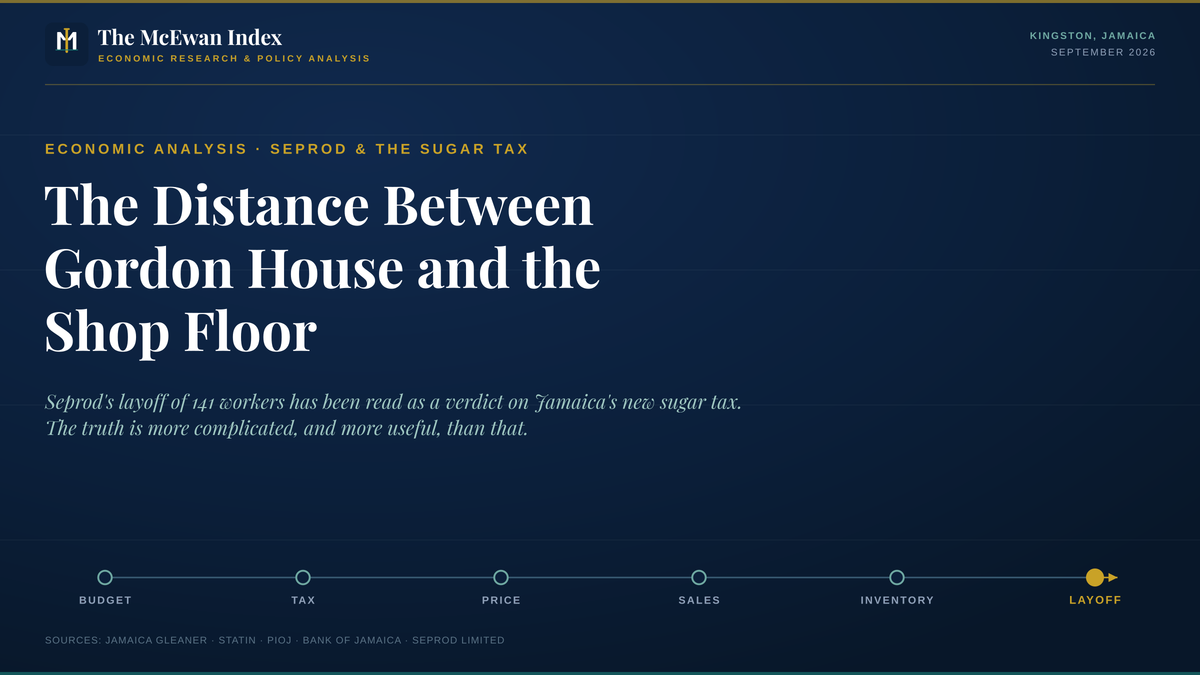
This is where a tax policy debated in the House of Representatives becomes something else entirely by the time it reaches a production schedule. A rate written in cents per gram of sugar becomes a shelf price. A shelf price becomes a purchasing decision. Enough changed purchasing decisions become a sales trend. A sales trend, sustained long enough, becomes inventory sitting in a warehouse. Inventory becomes a cash-flow problem. A cash-flow problem becomes a production adjustment. And a production adjustment, at the end of that chain, becomes a worker finding out their hours have been cut for three weeks.
Nobody voted on the worker's schedule. It arrived at the end of a transmission line that started somewhere else entirely.
The sugar tax, precisely
It is worth being exact about what the tax actually does, because most of the public debate around it has not been.
Jamaica's Finance Minister, Fayval Williams, announced a new Special Consumption Tax on non-alcoholic sweetened beverages in the February 2026 Budget presentation, as part of a wider $29.4 billion revenue package introduced in the aftermath of Hurricane Melissa. As originally designed, the tax was volume-based: $0.02 per millilitre, applied to any sweetened beverage regardless of how much sugar it actually contained. A 300ml drink would carry an extra $6, a two-litre bottle an extra $40.
That design drew criticism, including from tax specialists who pointed out that a volume-based levy gave manufacturers no real incentive to reduce sugar content. A drink with a small amount of added sugar and a drink saturated with it would be taxed the same way, as long as the bottle held the same volume. Following industry lobbying and debate with the parliamentary Opposition, Williams revised the structure when closing the Budget Debate in March. The SCT would instead be levied at 22 cents per gram of added sugar, effective May 1, 2026. A beverage with no added sugar attracts no tax at all. A beverage with a small amount of added sugar attracts a small tax. A beverage loaded with sugar attracts proportionally more. Williams described the logic as consistent with how alcohol is already taxed in Jamaica, by litres of pure alcohol rather than by bottle size.
The public health case behind the measure is not a minor or invented one. According to the Pan American Health Organization, 54 percent of Jamaican adults are overweight or obese, and non-communicable diseases account for roughly 80 percent of all deaths on the island. Childhood obesity more than doubled between 2000 and 2016, with sugary drinks identified as a significant driver. The tax is projected to raise approximately $10.1 billion in its first year, revenue the government has signalled it intends to direct, at least in part, toward public health priorities.
That is the strongest version of the case for the tax. It is a policy built on an externality argument: that the cost of untreated diabetes, hypertension and related illness does not fall only on the person who drank the sugary beverage, but on a public health system, a workforce and a state budget that all bear downstream costs. Taxing the product that contributes to that harm, and doing so in proportion to how much harm-causing sugar it actually contains, is a coherent way to try to shift behaviour before the health system absorbs the bill.
The harder question is what happens when that behavioural shift moves faster, or differently, than domestic producers can adjust to it. A manufacturer can reformulate a product, and Seprod has products across a range of sugar levels, both taxed and untaxed, that could theoretically absorb some of that shift. But reformulation, repackaging and repositioning a beverage portfolio takes time and capital. A tax can change consumer behaviour in a matter of weeks. A manufacturer's product line does not turn that quickly.
Who actually pays
There is a basic principle in tax economics that gets lost in most public discussion of the sugar tax: the person or company legally required to remit a tax is not necessarily the one who ends up bearing its cost. Economists call this tax incidence, and it depends almost entirely on how flexible each side of the transaction is.
Manufacturers can try to pass the tax fully into the retail price. If they do, and if consumers keep buying at roughly the same rate despite the higher price, the tax lands mostly on consumers. If manufacturers pass the tax on and consumers respond by buying less, or switching to a cheaper or untaxed alternative, the manufacturer absorbs the difference through lower sales volume rather than lower revenue per unit. If a manufacturer instead chooses to absorb part of the tax into its own margin, to keep the shelf price more competitive, then the cost falls on the company's profitability rather than the shopper's wallet.
In practice, the burden is rarely borne by only one party. Some of the cost is likely passed to consumers through higher prices. Some is likely absorbed by manufacturers through thinner margins on affected products. Retailers carrying that inventory face their own version of the same squeeze if the product moves more slowly off the shelf. And, as this episode shows, workers can end up bearing a portion of the cost too, not through the price of the drink itself, but through hours lost when a manufacturer scales back production to match slower sales. Shareholders bear it through whatever effect the episode has on profitability. The tax has one legal payer on paper. In practice, its cost travels through the entire chain.
Elasticity, in plain terms
Whether any of this becomes a serious problem for a manufacturer depends heavily on a concept economists call price elasticity of demand: how much the quantity people buy changes when the price changes.
Some products are relatively inelastic. People keep buying them even when prices rise, because there is no easy substitute or because the purchase is habitual and small enough not to prompt a rethink. Other products are elastic. Raise the price even modestly, and buyers peel away toward alternatives.
Sugar-sweetened beverages sit in an interesting middle ground. They are not necessities, which makes them vulnerable to substitution. But they are also habitual purchases with strong brand loyalty, which can dampen how quickly consumers actually switch. When the price of a sugary drink rises, a Jamaican consumer has several ways to respond. They can buy water instead. They can shift to a zero-sugar or reduced-sugar version of the same brand, which the tax structure specifically rewards. They can trade down to a cheaper, less-known brand. They can buy a smaller package rather than the family size. They can make juice or a cold drink at home rather than buying it bottled. Or they can simply buy less of everything discretionary, sugary drinks included, because their overall budget is tighter than it was a year ago.
For a manufacturer like Seprod, which sells across several of the price and sugar-content tiers itself, some of that substitution is not fully lost revenue. A consumer trading down from a high-sugar Seprod product to a low-sugar Seprod product still buys from Seprod. But if the substitution moves toward a cheaper import, a competitor's product, or away from bottled beverages altogether, that is a real revenue loss, and it is precisely the kind of shift that shows up first as slower sales and only later as an inventory problem.
The inventory problem
Of everything Pandohie said, the inventory point deserves the most attention, because it is the clearest evidence that this is not simply a public relations response to an unpopular tax.
The chain runs in a predictable direction. Weaker demand leads to lower sales. Lower sales, if production continues at the same pace, leads to inventory piling up in warehouses. That accumulated inventory ties up working capital that would otherwise be available for other uses, from paying suppliers to servicing debt to funding new investment. As that pressure builds, a company faces a choice: discount the product aggressively to move it, which erodes margin, or slow production to let sales catch up with what has already been made. Seprod appears to have chosen the second option, and a temporary, rotating layoff is what that choice looks like on a factory floor.
A warehouse full of unsold product is sometimes mistaken for a sign of strength, evidence that a company built up capacity to meet demand. It is usually the opposite. Beverages and food products have shelf lives. Inventory that sits too long risks expiring, being marked down, or being written off entirely, each of which is a direct hit to profitability. Slowing production to let inventory normalise is, in that sense, a disciplined response rather than a panicked one. It is what a well-managed company does when it sees a problem building, rather than waiting for it to become a write-off.
Tourism's hidden multiplier
Pandohie specifically flagged the hotel industry, and that reference deserves more attention than it has received.
Hurricane Melissa made landfall in western Jamaica on October 28, 2025, as a Category Five storm, damaging an estimated 40 to 50 percent of the island's hotel stock. Ten months later, roughly 70 percent of hotel rooms were back in service, with 30 percent still offline. Stayover arrivals were down 27.5 percent in the first quarter of 2026 compared with the same period a year earlier. By the end of August, that gap had narrowed considerably, with arrivals running about 17 percent below the prior year and tourism revenue down roughly 18 percent, according to figures released by Tourism Minister Edmund Bartlett. The recovery has been faster than many feared, but the sector has spent most of 2026 operating meaningfully below its pre-hurricane capacity.
Hotels are not simply hospitality venues. They are large, recurring procurement customers for Jamaican manufacturers, buying juices, dairy products, condiments, snacks and beverages at volumes that matter to companies like Seprod. When hotel occupancy falls, or when a third of room inventory sits offline for the better part of a year, that procurement demand falls with it. This is the basic mechanism of an economic multiplier: a shock in one sector does not stay contained to that sector. It moves through supply chains into manufacturing, into transportation that moves goods to hotels, into agriculture that supplies hotel kitchens, and into the employment tied to all of it.
STATIN's own data on the sector illustrates the scale of the initial hit. Accommodation and Food Services, as a share of the broader Services Industry, plunged 31 percent in late 2025 as hotel closures coincided with a 43 percent decline in foreign arrivals. A manufacturer whose customer base includes hotel procurement was always going to feel that, even if the connection is less visible to the public than arrival statistics.
Hanover and an uneven recovery
Pandohie's reference to Hanover deserves to be read as more than a passing detail. Hanover sits on Jamaica's northwestern coast, in the same tourism corridor hit hardest by Hurricane Melissa. If retailers there are still recovering nearly a year after the storm, that tells a story about the unevenness of Jamaica's broader rebound.
The Planning Institute of Jamaica has been careful to describe the national recovery in cautiously positive terms. Seasonally adjusted output rose 3.3 percent in the January-to-March 2026 quarter compared with the hurricane-battered final quarter of 2025, and PIOJ officials have said outright that Jamaica is not in a recession. But a national average can mask sharply different experiences at the parish level. A retailer in Hanover, dependent on tourism-adjacent foot traffic and local household spending in a parish still working through hurricane damage, is not necessarily recovering on the same timeline as an aggregate GDP figure suggests. When a national manufacturer says regional retailers are still struggling to recover, that is a data point about the shape of the recovery, not just its speed.
The consumer is already stretched
Bring the story back to the household, and a fuller picture of why demand might be softening starts to emerge.
Jamaica's point-to-point inflation rate climbed to 7.5 percent in July 2026 and 7.9 percent in August, both comfortably above the Bank of Jamaica's target range of 4 to 6 percent. Food and non-alcoholic beverages, the heaviest-weighted category in the consumer price index, rose 1.5 percent in August alone, and transport costs climbed sharply over the preceding year, driven by fuel prices and successive increases in route taxi and hackney carriage fares. Unemployment, while still low by Jamaica's historical standards, drifted up from 3.3 percent in October 2025 to 3.7 percent in April 2026, with labour force participation also declining and youth employment falling nearly 10 percent year over year.
The Jamaica Chamber of Commerce's quarterly Business and Consumer Confidence survey, conducted by Market Research Services, captured a similar mood. Consumer confidence rebounded 5.7 percent in the first quarter of 2026 as the immediate shock of Hurricane Melissa faded, but reversed course in the second quarter, falling 2.3 percent. Don Anderson, the pollster who has run the survey for a quarter of a century, described Jamaican consumers as increasingly cautious, wary of what is coming, and less positive about current business conditions than the headline recovery numbers might suggest.
None of that proves the sugar tax broke anyone's budget on its own. But it establishes the environment into which the tax landed. A household already absorbing food inflation above 7 percent, rising transport costs, and a less certain job market does not have unlimited room to absorb one more price increase without adjusting something in its basket. The additional cost on sugar-based juices did not arrive in isolation. It arrived on top of a year households had already spent tightening their belts.
What the data actually says
It would be a mistake to read one company's temporary layoff as proof that Jamaica's economy is in serious trouble. It would be an equally serious mistake to dismiss it as meaningless because it involves only one company.
Economists generally distinguish between several tiers of evidence. Anecdotal evidence is a single account, useful for illustration but not for inference. Company-level evidence, like Seprod's layoff, tells you something happened at one firm, for reasons that firm's own management has described. Sector-level evidence aggregates that experience across many firms in the same industry, which starts to reveal whether a pattern exists. Macroeconomic evidence, the broadest tier, captures the behaviour of the entire economy across output, employment, prices and spending.
Right now, Jamaica has genuine macroeconomic evidence of a difficult year: GDP contracted 7.3 to 7.5 percent in the final quarter of 2025 due to Hurricane Melissa, and by 5.9 percent year over year in the first quarter of 2026, even as the economy showed a seasonally adjusted rebound compared with the hurricane quarter itself. The full 2025/26 fiscal year is now estimated to have contracted 1.7 percent, a sharp reversal from the roughly 1.9 percent growth projected before the storm. The PIOJ forecasts a return to growth of 1 to 3 percent in the 2026/27 fiscal year, though it has flagged risks from global oil prices and the pace of tourism recovery.
What Jamaica does not yet have, at least not in the public data, is sector-level confirmation that manufacturing broadly is experiencing the same inventory and demand pressure Seprod has described. That is the piece of evidence that would move this from a company-specific story to a genuine early-warning signal. It would show up in indicators such as the Jamaica Manufacturers and Exporters Association's sector surveys, in STATIN's manufacturing output figures for the second and third quarters of 2026, in retail sales data, and in whether other listed consumer goods companies report similar inventory build-ups in their upcoming Jamaica Stock Exchange disclosures. Until that broader evidence appears, one company's decision remains exactly that: one company's decision, made for reasons specific to its own portfolio, informed by conditions that are genuinely economy-wide.
It is also worth being honest about what Seprod's own financial results show, because they complicate any narrative of a company in crisis. The group closed 2025 with revenue of roughly $153.6 billion, up 15 percent year over year, and profit that nearly doubled to around $5 billion. But that momentum has not carried cleanly into 2026. Seprod's revenue declined year over year in both the first and second quarters of 2026, even as the company managed to grow net income through tighter cost control. That is a company defending its margins while its top line softens, not a company in financial distress. It is precisely the kind of pressure that leads a disciplined management team to trim production before the problem shows up in a much larger writedown later.
The McEwan Test
It is worth applying a simple framework to this episode, one built around five questions that any economic policy should be able to answer.
What problem is the policy trying to solve? The sugar tax targets a genuine public health burden: obesity and non-communicable disease rates that are among the highest in the region, with sugary beverages identified as a contributing factor.
Who pays for the policy? In the near term, the cost is distributed across manufacturers absorbing margin pressure, retailers carrying slower-moving inventory, consumers facing higher shelf prices on higher-sugar products, and, in at least this one instance, workers experiencing reduced hours.
Who benefits? The intended long-term beneficiaries are public health outcomes and the fiscal capacity to fund them, assuming the projected $10.1 billion in revenue is directed toward that purpose. Manufacturers that reformulate toward lower-sugar products also stand to benefit competitively over time, since the tax structure specifically rewards lower sugar content.
What unintended consequences could emerge? A short-term demand shock that outpaces manufacturers' ability to reformulate their product lines, concentrated impact on specific factories or product categories rather than the sector as a whole, and the risk that a policy justified on health grounds is instead remembered publicly as a job-loss story.
How will we know whether the policy worked? Not from revenue collected alone. It will require tracking actual sugar consumption over time, obesity and diabetes prevalence trends, the pace and depth of product reformulation across the beverage industry, and whether employment and output in the sector stabilise once manufacturers adjust their portfolios. A policy that raises $10 billion but shows no measurable change in consumption or health outcomes has not succeeded on its own terms. A policy that shifts consumption toward lower-sugar products with only a temporary disruption to production has arguably worked as designed.
The transmission mechanism
There is a useful way to think about workers in moments like this: not as bystanders to economic policy, but as the mechanism through which policy becomes tangible.
A tax rate is a line in a Budget document until it changes a shelf price. A changed shelf price is a pricing decision until enough consumers respond to it that sales figures move. A sales decline is a spreadsheet entry until it becomes physical inventory sitting in a warehouse. Physical inventory is a balance sheet item until it becomes a cash-flow constraint. A cash-flow constraint is a management problem until it becomes a production decision. And a production decision remains abstract until it becomes a name on a rotation schedule, a person who now has three fewer weeks of full pay to plan around.
That is not a criticism of policy, or of Seprod, or of the consumers who changed what they bought. It is simply how a modern economy actually transmits decisions made far from the factory floor down to the people who work on it. Understanding that chain does not require taking sides. It requires taking the chain seriously.
The trade-off Jamaica has to sit with
None of this resolves into a clean verdict, and it should not. A tax can be well designed, publicly justified, and still produce short-term costs that fall unevenly on the people least equipped to absorb them. A manufacturer can be profitable, well managed, and still make a painful production decision because a hurricane, a tight consumer, and a new tax all landed inside the same eighteen-month window. Consumers can respond entirely rationally to higher prices by buying less, and that rational response can still cost someone else their full paycheque for three weeks.
The question this episode should leave Jamaica with is not whether the sugar tax was a good idea or a bad one. Reasonable people, looking at the same public health data and the same industry pushback, can land in different places on that question, and both sides have a legitimate case. The more useful question is how the country measures the full economic cost and benefit of a policy once it travels from a Budget document to a consumer, to a manufacturer, and finally to a worker. Jamaica has decent tools for measuring the fiscal side of that journey. It has far weaker tools for measuring what happens once a policy reaches the factory floor.
Seprod's 141 workers will be back on their full schedules within weeks. The tax, the hurricane recovery, the tight household budgets and the inventory sitting in that warehouse will still be there long after the rotation ends. Whether this was a one-off adjustment or an early signal of something broader will not be settled by this article, or by Seprod's next earnings call alone. It will be settled by whether the data over the next two quarters, in manufacturing output, in retail sales, in the earnings of Seprod's peers, tells the same story this one company just did.
That is the number worth watching. Not 141. What comes after it.