Jamaica Has Taken Britain to the Question It Never Fully Answered

By Janiel McEwan, Economist and Researcher
On the evening of Sunday, September 6, 2026, a congregation gathered at a church in south London for a service of "remembrance, justice and repair." Jamaica's Minister of Culture, Gender, Entertainment and Sport, Olivia Grange, sat among them, a day before she would carry a document to Buckingham Palace. The service was not incidental. It was the quiet register in which the following day's legal act was meant to be understood, not as a demand shouted across an ocean, but as a petition, filed in the oldest language the British constitutional system possesses.
The next morning, Grange stood outside Buckingham Palace holding that document aloft. She posted a photo on social media with the caption, "The petition has been filed." King Charles III was not there to receive it himself. British reporting on the day noted he was away on vacation. The petition instead went through the machinery that has handled such things since long before Jamaica existed as a nation: it was lodged with the Palace, addressed to the King in his capacity as Jamaica's constitutional head of state.
This is worth sitting with before the analysis begins. Jamaica did not go to a foreign court. It went to its own head of state, using its own constitutional architecture, to ask that architecture to examine the legal foundations of the system that produced modern Jamaica. That is the fact almost every early headline missed. This is not simply another diplomatic argument between a small Caribbean nation and a large European one. It is a former colony asking the residual legal apparatus of empire to audit itself.
What Jamaica actually asked for
Grange has been unusually disciplined about what the petition is not. She has stressed that it is not a demand for immediate payment, and Jamaica intends to decide its next legal moves only after it receives a response. The petition asks the King to exercise a discretionary power, dating to the Judicial Committee Act 1833, to refer three specific legal questions to the Judicial Committee of the Privy Council, the institution that remains Jamaica's final court of appeal.
The three questions, reported consistently across British and Caribbean coverage, are:
- Was the forced transport of Africans to Jamaica, and their subsequent enslavement, unlawful under English common law?
- Did that enslavement violate international law, and does the United Kingdom bear responsibility for it?
- Does the United Kingdom have a legal obligation to provide a remedy for the harm caused?
Notice what is absent. There is no figure named. There is no defendant summonsed. There is no court date. Jamaica has asked for a legal opinion, not a verdict, and the distinction is the entire architecture of the strategy.
It matters here to be precise about vocabulary, because sloppy language is exactly what will let this story be misunderstood by people on both sides of the Atlantic.
A petition is a formal request addressed to an authority, in this case the Crown, asking it to exercise a discretionary power. It creates no legal obligation on its own.
A reference, under Section 4 of the Judicial Committee Act 1833, is the mechanism by which the King, acting on ministerial advice, can send a question to the Judicial Committee for consideration when it cannot be resolved through the ordinary courts.
An advisory opinion is the Judicial Committee's answer to a referred question. It clarifies the law. It does not, by itself, order anyone to do anything or pay anything.
A court judgment, by contrast, resolves a live dispute between named parties and can carry direct legal consequences, including orders to pay damages.
A reparations claim is the broader political and legal demand that a state or institution address a historical wrong.
Compensation and restitution are two of the possible remedies within that demand: compensation typically means a payment for harm suffered, restitution means the return of what was taken, whether wealth, land, or, as with the artefacts discussed below, physical cultural objects.
Reparatory justice, the term CARICOM prefers, is broader still. It treats money as only one possible instrument among many, alongside apology, debt relief, development financing, and institutional reform.
Jamaica's petition sits at the very first rung of that ladder. It asks a question. It does not, on its own, put a cheque in anyone's hand, and no reader should come away from this story believing that King Charles has been sued for $10 billion, or that Britain has been ordered to pay anything. What Jamaica has done is more patient, and arguably more consequential: it has tried to convert a decades-old political argument into a formal legal one.
Why the King, and why this obscure old court
The reason a Jamaican petition lands on a British king's desk at all is constitutional, not sentimental. Jamaica became independent in 1962, but it did not become a republic. King Charles III remains its head of state, represented locally by a Governor-General, and Jamaica remains within the jurisdiction of the Judicial Committee of the Privy Council as its final court of appeal, a position it has debated leaving in favour of the Caribbean Court of Justice for years without yet doing so.
The Judicial Committee's origins reach back further than the British Empire's most notorious chapters. The right to petition the Crown over grievances in the administration of justice traces to the Norman Conquest of 1066, when the King was regarded as the "fountain of justice throughout his Dominions," according to the Committee's own account of its history. What began as the monarch's personal judicial authority evolved, through the Judicial Committee Act 1833, into a standing body. That 1833 law made the Committee the highest court for civil and criminal appeals across the British Empire, and when the Empire gave way to the Commonwealth after the Second World War, the Committee kept that role for the states that chose to retain legal ties to the United Kingdom.
Buried inside that same 1833 statute is the provision Jamaica is now trying to use. Legal analysis of the petition explains that Section 4 of the 1833 Act gives the Committee power to issue advisory opinions on matters that "cannot be effectively decided in ordinary courts," with the King able to refer such matters at his discretion, acting in practice on the advice of his ministers. This provision is rarely invoked. It exists for exactly this kind of situation: a question that no domestic Jamaican court could resolve, because it concerns acts committed under the authority of an imperial legal order that predates Jamaica's own courts.
It is important not to overstate what this means. Constitutional scholars have been blunt that the King will almost certainly decline to refer Jamaica's questions to the Committee, precisely because the request is so far outside the ordinary run of litigation. One expert on the monarchy and constitutional law described the manoeuvre as clever, because it uses a rarely touched procedural lever to force engagement with a politically explosive question through legal rather than diplomatic channels. Buckingham Palace's own public response was carefully neutral: a spokesperson confirmed the Palace was aware Jamaica was seeking a hearing before the Committee, while making clear the King has no personal role in judging the substance of the claim.
The legal strategy behind Jamaica's petition did not emerge overnight. British reporting has traced the region's case-building back to 2013, when CARICOM began working with human rights lawyers, reportedly including a barrister who is now the UK government's own chief legal adviser, on a template partly inspired by a 2013 settlement in which Britain compensated Kenyan victims of torture committed during the 1950s Mau Mau emergency. That case matters here because it shows a British government has, at least once, agreed to pay for colonial-era harm rather than fight it to a legal dead end, though the Mau Mau claims involved living survivors and documented individual abuse decades closer to the present, an evidentiary distance Jamaica's much older claim does not have.
Even if the reference is granted, and even if the Judicial Committee eventually issues an opinion, that opinion would clarify law. It would not, on its own, function as a damages award. Jamaica understands this. Grange's own language, that once answers arrive, "our attorneys, our lawyers, will determine what the next move is," describes a multi-stage strategy, not a single legal knockout blow.
Slavery as an economic institution, not only a moral tragedy
To understand why Jamaica is doing this now, it helps to look past the courtroom and toward the ledger.
Jamaica came under English control in 1655. Over the following two centuries, British merchants forcibly transported an estimated 600,000 to a million Africans to the island, where sugar, and to a lesser extent coffee and other cash crops, built one of the most profitable colonial economies in the empire. The people who produced that wealth were enslaved Africans and their descendants. The people who owned the plantations, controlled the shipping routes, financed the voyages, and insured the cargo were overwhelmingly British merchants, absentee landlords, and metropolitan financial houses.
The monarchy itself was not a bystander to this system. It was Charles II, in the 1660s, who put royal capital directly behind the trade, chartering the Royal African Company as a state-backed venture in human trafficking, a fact reparations researchers treat as central to why the Crown, specifically, rather than only Parliament or private planters, is a defensible target for Jamaica's petition.
This is the part that a purely moral framing of slavery tends to obscure: it was, first and foremost, a system for the extraction and transfer of wealth. Enslaved people were legally classified as property, which meant their labour, their children, and often their lives could be bought, sold, mortgaged, and insured like any other commodity. Sugar profits flowed to plantation owners in Jamaica and, increasingly over time, to absentee owners resident in Britain. Trade profits flowed to Liverpool, Bristol, London, and Glasgow merchant houses. Insurance and credit flowed through institutions that would become recognisable ancestors of modern British banking and underwriting.
When emancipation came, the pattern repeated in an even starker form. Plantation owners inherited compensation, inherited land, and inherited political power. The formerly enslaved inherited neither land, nor capital, nor the vote, nor, in the main, formal education. Understanding slavery as an economic institution, not only a historical wound, is what allows the reparations argument to be evaluated in economic terms rather than only sentimental ones, and it is the frame this publication intends to hold throughout.
The £20 million question
In 1833, Parliament passed the Slavery Abolition Act, which freed enslaved people across most of the empire from 1834, though many were bound into a further period of unpaid "apprenticeship," initially set at ten years and later reduced to four. Compensation, not to the formerly enslaved but to their owners, for the loss of their human property, followed under the Slave Compensation Act of 1837. The sum was £20 million, a figure so large the government could not simply pay it out of revenue and instead borrowed the money, a debt that was only fully paid off in 2015. Of that £20 million, CARICOM's own reparations research puts roughly £16.5 million, or 82.5 percent, in the hands of enslavers in the Caribbean specifically, with most of the remaining £3.5 million going to enslavers in Mauritius and the Cape Colony, across some 46,000 individual payments, a spread that shows how widely the compensation, not the enslavement itself, was distributed through the British public.
Grange has made this fact central to her argument, framing it in a memorable if slightly loose shorthand: for generations, British taxpayers were, in effect, still servicing a debt originally taken out to compensate people for owning human beings. The more precise point, and the one worth preserving, is that the compensation loan's final tranche of interest payments was retired only in 2015, meaning the financial instrument created to pay slave owners outlived the twentieth century entirely.
There is a second, less-quoted half of that 1833 settlement that sharpens the point further. Beyond the £20 million cash payment to owners, the newly freed were also required to work without wages for their former enslavers during the apprenticeship period, labour reparations researchers value at a further £27 million. Add the two together and, on that accounting, the formerly enslaved effectively financed close to half of their own emancipation, in kind, on top of receiving nothing themselves.
The uncomfortable question that follows is not really about numbers. It is about symmetry. Slave owners received compensation for the loss of enslaved people as property. The enslaved people themselves, and their descendants, received nothing for the loss of their freedom, their labour, their family structures, or their accumulated human capital. That asymmetry, not any single statistic, is the moral centre of the reparations argument, and it is one almost impossible to dispute on the facts.
None of this means today's British taxpayer personally owned an enslaved person, or bears individual guilt for an eighteenth-century transaction. It is important to distinguish between the individual slave owners who received compensation in 1833, the corporations and financial institutions that profited from financing and insuring the trade, the colonial and metropolitan state that authorised and administered the system, and the ordinary citizens of modern Britain, most of whom have no traceable personal connection to any of it. Reparations arguments that collapse this distinction, treating every modern Briton as a personal debtor, do the cause more harm than good. The stronger argument is institutional and state-level, not personal.
Follow the money: what did slavery build?
The most intellectually serious version of the reparations argument does not stop at compensation. It asks a bigger question: how much of Britain's subsequent economic development rests on wealth extracted from colonies like Jamaica?
The most influential answer came from the Trinidadian historian and later prime minister Eric Williams, whose 1944 book Capitalism and Slavery argued that profits from Caribbean slavery gave Britain the commercial and industrial capital that helped power its eighteenth-century industrial revolution, and that abolition itself followed economic decline in the plantation system as much as moral conviction. It is one of the most influential books ever written on the subject, and it reshaped how an entire field understood industrialisation.
It is also, honestly, a contested thesis. Subsequent generations of economic historians produced what one academic review called a general consensus that Williams' arguments were more provocative than persuasive in their strongest form, particularly the claim that slave-trade profits were themselves large enough to have financed the Industrial Revolution outright. Other scholars have pushed back the other way, arguing the underlying insight, that slavery and empire meaningfully shaped Britain's pattern and timing of growth even if they did not single-handedly cause it, has held up better than its critics allow.
This publication will not pretend that debate is settled, because it is not. What can be said with confidence, and what modern archival projects like University College London's Legacies of British Slavery database have documented in granular detail, is that compensation money, plantation profits, and slave-trade-linked capital flowed into British banking, insurance, shipping, some universities, and substantial private and public infrastructure. The scale of that flow relative to Britain's total industrial development remains a live scholarly argument. The fact of the flow itself is not.
What Jamaica inherited
If the historical question is what wealth left Jamaica, the development question is what Jamaica was left with. At emancipation, the formerly enslaved received no land, no capital, no education infrastructure, and no political voice. Plantation structures persisted largely intact, with wage labour replacing unpaid labour on terms still heavily controlled by the same landowning class. Literacy, health infrastructure, and access to credit remained concentrated among a small elite for generations after 1838, and colonial political exclusion continued in various forms until well into the twentieth century.
The honest, economically serious version of this argument resists a temptation to blame every present-day Jamaican economic problem on slavery. Some present inequalities connect clearly to historical land concentration and the post-emancipation labour system. Others, from specific governance failures to more recent policy choices, do not trace back that far and should not be dressed up as though they do. Credibility here depends on making that distinction explicit rather than letting the reader assume that history explains everything.
What reparatory justice actually means
CARICOM, the regional bloc of which Jamaica is a leading member, has spent over a decade building the intellectual architecture for this argument through its Reparations Commission, chaired by the historian Sir Hilary Beckles. Its foundational document, the Ten Point Plan for Reparatory Justice, first adopted in 2014, deliberately treats reparations as a basket of remedies rather than a single cheque: a formal apology, debt cancellation, an African knowledge programme, investment in public health given the epidemiological legacy of slavery, illiteracy eradication, a cultural institutions and repatriation programme, psychological rehabilitation, technology transfer, and development financing among them.
That framework has just been revised again. In July 2026, CARICOM Heads of Government approved a revised Ten Point Plan, titled "A Manifesto for the Coming Enlightenment," under Beckles' continued leadership, with the region's Prime Ministerial Subcommittee on Reparations tasked with advising on priority actions ahead of the Commonwealth Heads of Government Meeting in Antigua and Barbuda this November. The revision sharpens the plan's legal arguments and, notably, gives new weight to the disproportionate impact of slavery and colonialism on women and girls, alongside climate justice, an argument CARICOM grounds in the observation that plantation-era environmental degradation contributed to the ecological vulnerability the Caribbean now faces from storms it did little to cause.
Reparatory justice, in this framework, is explicitly not understood as a transfer payment to be spent and forgotten. It is meant to fund institutions and capacity: health systems, literacy programmes, cultural repatriation, technology transfer, and debt relief, precisely because CARICOM's own diagnosis is that the persistent harm of slavery operates through institutions, not simply through a missing sum of money.
If reparations ever arrive, what should Jamaica do with them?
This is where a serious economics publication has to go further than the political debate usually does. Suppose, for argument's sake, that some form of reparatory resource eventually reaches Jamaica, whether through a negotiated settlement, a development partnership, or a court-backed remedy years from now. What should happen to it?
The wrong answer, and the temptation any government would face, is to fold the money into recurrent expenditure: a budget top-up, a subsidy, a one-off transfer. That would spend a once-in-a-generation resource on ordinary annual pressures, and it would vanish within a single fiscal cycle without changing Jamaica's underlying productive capacity.
The economically serious answer treats reparatory resources as capital, not consumption. That means directing them toward assets that keep generating value long after the initial transfer: early-childhood development and education, given how strongly human capital investment compounds across a generation; healthcare infrastructure; land reform and housing; renewable energy and climate resilience infrastructure, given the direct link CARICOM itself draws between plantation ecology and current climate exposure; digital infrastructure; research and development capacity anchored at institutions like The University of the West Indies; and support for entrepreneurship and industrial diversification away from Jamaica's continued overreliance on a narrow set of export sectors.
One structure worth proposing, and this publication offers it explicitly as a policy idea rather than an existing government commitment, is a Jamaican Reparatory Development Fund: a ring-fenced, professionally governed vehicle, modelled loosely on sovereign wealth fund principles, designed to convert any reparatory inflow into a permanent productive asset base rather than a temporary budget line. Such a fund would need independent governance, parliamentary oversight, external auditing, and published development targets from day one, precisely because a fund without those guardrails would simply become another avenue for the governance failures this publication has spent the year documenting elsewhere.
The $10 billion question
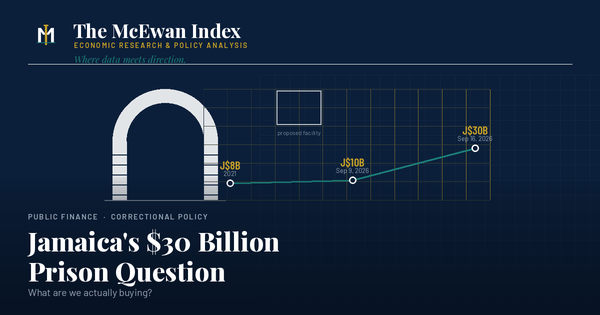
The figure most associated with Jamaica's claim, roughly US$10 billion, did not originate with the 2026 petition. It traces to a private member's motion filed in the Jamaican Parliament in 2021 by lawmaker Mike Henry, who calculated the sum as roughly equivalent, in today's terms, to what Britain paid to slaveholders after abolishing slavery in 1834, the same £20 million compensation package discussed above, adjusted forward. In other words, the widely repeated $10 billion figure is not an estimate of lost output, forced labour value, or intergenerational harm. It is, more narrowly, a modern-value estimate of one specific historical cash transfer, the compensation paid to enslavers.
That is one legitimate methodology among several, and it is far from the only one in circulation. CARICOM's own reparations research cites a cluster of far larger regional estimates, calculated on an entirely different basis, running from the 2005 Beckford Report's £7.5 trillion, roughly US$13.65 trillion, up to the Brattle Group's 2023 assessment of US$24 trillion, a study associated with the Jamaican jurist and former International Court of Justice judge Patrick Robinson, alongside separate quantifications from the Repair Campaign, a 2018 Indigenous Peoples' Rights International report, and the economist Jason Hickel. Those figures cover the whole Caribbean region's claim against multiple enslaving nations, not Jamaica's claim against Britain alone, which is itself a reason they cannot be compared directly to Jamaica's own $10 billion figure. The distance between $10 billion and tens of trillions of dollars illustrates exactly why this publication has resisted treating any single figure as authoritative. Different methodologies (compensation-equivalent, lost-output, unpaid-wages, human-capital-value, region-wide versus single-nation) produce wildly different answers, because they are measuring conceptually different things at conceptually different scales.
Whether centuries of forced labour can be reduced to a single number at all is a genuine philosophical and economic problem, not a rhetorical one. What can be said is that if any number is ultimately required for negotiation, as opposed to simply for public advocacy, it will need a transparent, published methodology that both sides can interrogate, rather than a headline figure asserted without derivation. Jamaica's own $10 billion has one virtue in that respect: its methodology, however narrow, is at least publicly traceable.
Britain's position, stated plainly
Successive British governments have declined to pay reparations or offer a formal apology, while variously describing the slave trade as abhorrent. That position held under the previous Conservative government, held under Keir Starmer's Labour government, and holds under the current Downing Street. Responding to the 2026 petition, a spokesperson for Prime Minister Andy Burnham's office said the UK's position on reparations is clear: "the UK does not and will not make reparations."
The strongest version of the British government's case, stripped of political framing, rests on several genuine legal and philosophical difficulties. Modern international human rights law did not exist when the slave trade operated, so applying today's legal categories backward across centuries raises real questions about retroactivity. Individual liability is hard to establish when both the people who profited and the people who suffered are long dead, and identifying which living Britons, if any, should be considered morally or financially responsible for choices made by ancestors under a wholly different legal order is genuinely contested, not merely evasive. There is also a coherent worry about precedent: if Britain accepts liability here, does that open an unbounded chain of historical claims stretching back through every conquest, war, and economic exploitation in recorded history, against which no modern state could ever fully insure itself?
The sharpest public version of this argument came from Lord Sumption, a former UK Supreme Court justice, who dismissed the legal premise of Jamaica's claim outright as "nonsense" on BBC Radio 4, arguing that Britain's loss of confidence in its own history, rather than any genuine legal entitlement, is what has opened the door to the claim. That is a serious, informed legal opinion, not a caricature, and it deserves to be weighed rather than waved away, even by a publication sympathetic to Jamaica's case.
These arguments deserve to be stated fairly, because a reader who is sceptical of reparations should be able to recognise their own position in this article, not a caricature of it.
Answering the counterargument
The strongest response does not dispute any of that logic on its own terms. It disputes the framing that collapses three genuinely distinct kinds of responsibility into one.
Legal liability asks whether a specific, enforceable legal obligation exists today, under either English law as it stood at the time or international law as it has since developed. This is precisely the narrow, technical question Jamaica's petition is designed to test, and it may well come back unfavourable to Jamaica, given how cautious the Judicial Committee tends to be about matters that bypass ordinary litigation.
Moral responsibility asks whether the beneficiary institutions, principally the British state and the Crown as a continuous legal and institutional entity, bear an ethical obligation given the scale of documented harm and the scale of documented benefit, regardless of whether any living individual is personally at fault.
Developmental responsibility asks a more forward-looking question entirely: given that historical extraction demonstrably shaped Jamaica's starting conditions at independence, does Britain have a practical stake, separate from either legal or moral obligation, in supporting the region's development now, as a matter of enlightened long-term interest rather than backward-looking guilt?
Britain can lose the first argument, the narrow legal one, and still have a serious case to answer on the second and third. That three-way distinction, rather than any single verdict from any single court, is the intellectual key that allows this debate to proceed without either side needing to declare total victory or total defeat.
King Charles's actual position, not the one attributed to him
It would be easy, and wrong, to attribute a fixed position to King Charles that he has not taken. He has not apologised for slavery. He has not endorsed financial reparations. His language on this has evolved carefully but consistently. Months before becoming king, at a Commonwealth summit in Kigali in June 2022, he spoke of his "personal sorrow" over Britain's role in the slave trade, a phrase his son and heir, Prince William, echoed almost verbatim on a visit to Jamaica the same year. In April 2023, as king, he went a step further procedurally, if not rhetorically, granting researchers full access to the Royal Archives and Royal Collection to study the monarchy's own historical ties to the trafficking of enslaved Africans, the same body of evidence CARICOM's own reparations research now cites. Then, most notably at the Commonwealth Heads of Government Meeting in Samoa in October 2024, he acknowledged the weight of the history without crossing into either apology or liability. He told assembled Commonwealth leaders that none of them could change the past, but that they could commit to "finding creative ways to right the inequalities that endure." That is an acknowledgement of historical wrong and a call for some form of forward-looking remedy. It is not an apology, and it is not an acceptance of legal or financial responsibility. That gap, between sorrow and liability, is not an accident of phrasing. It is the entire diplomatic strategy of the modern monarchy on this question, and Jamaica's petition is specifically engineered to force a more precise answer than that gap has so far allowed.
The British Museum, a related but separate fight
Alongside the legal petition, Grange has also been pursuing the return of specific cultural artefacts from the British Museum, most prominently a set of carved wooden Taíno "zemí" figures, including one associated with the rain deity Boiyanel, discovered in a Jamaican cave in 1792 and later acquired by the museum through the early twentieth-century Oldman collection. It is worth stating plainly that these particular objects were not seized during the slave trade itself, and were not stolen in the sense of being looted during conquest; they entered British hands through the ordinary channels of colonial-era archaeology and private collecting.
That distinction matters, because conflating cultural repatriation with slavery reparations, while emotionally intuitive, muddies two separate legal and ethical arguments: one concerns the ownership of specific physical objects with clear provenance, the other concerns systemic economic harm with no single physical artefact attached to it. Jamaica has made real progress on the narrower artefact question, including an invitation for Jamaican curators to examine the museum's holdings directly, progress that has nothing to do with whether the Judicial Committee ever issues an opinion on the three legal questions above.
The Zong, and why the timing was chosen deliberately
The petition's filing date was not arbitrary. It was timed to coincide with the anniversary of the day in 1781 when the Liverpool-registered ship Zong set sail from West Africa carrying 442 enslaved Africans. When water supplies ran low during the crossing, the crew made a calculated decision: rather than let the weakened captives die of natural causes, which would not be covered by the ship's insurance, they threw over a hundred men, women, and children into the sea, because insurance law at the time allowed a claim for "cargo" deliberately jettisoned to save a vessel, but not for cargo that simply died.
When the ship's owners filed that insurance claim, the underwriters refused to pay, and the resulting case, Gregson v Gilbert, reached England's Court of King's Bench in 1783. The dispute at trial concerned whether the underwriters owed the ship's owners roughly £3,660 for the enslaved people killed, a routine commercial argument over cargo loss dressed in the language of insurance law, decided by a court that never once considered whether a crime had been committed. That is the detail that makes the Zong such an enduring symbol: English law, applied exactly as written, treated the deliberate killing of over a hundred people as a question of maritime average, not murder. The case became a rallying point for British abolitionists, including Granville Sharp, precisely because it exposed the logic of the entire system with unusual clarity: under the law as it stood, human beings could be killed profitably, provided the paperwork was filed correctly. Choosing that anniversary for the petition was Jamaica's way of saying the case it wants examined is not really about a number. It is about whether a legal system that permitted this was ever capable of producing a just outcome for the people it classified as property.
The date carries a second layer of meaning that has gone largely unremarked in the international coverage. September 7 is also the exact first anniversary of the Addis Ababa Declaration, signed in Ethiopia in 2025 when CARICOM and the African Union jointly committed to a coordinated reparatory justice campaign and a formal AU-CARICOM reparations mechanism. Filing on that date, in addition to the Zong anniversary, signals that Jamaica's petition, however national and legalistic in form, was launched as a deliberately timed opening move within a wider, coordinated Caribbean-African campaign rather than as an isolated national initiative.
CARICOM, the African diaspora, and a UN resolution that changes the language without changing the law
Jamaica's petition did not happen in isolation. It sits inside a much larger regional and international current, one considerably older than CARICOM itself. As early as 1957, on the eve of the short-lived West Indies Federation, Caribbean political leaders formally demanded £200 million from Britain for development financing, a request Britain rejected, as it did every subsequent version of the same ask for the next several decades. The economist Sir Arthur Lewis, who would later win the 1979 Nobel Prize in Economics, was arguing by the 1930s that Britain's colonial wealth carried an unrepaid "black debt" to the islands whose unpaid labour helped generate it, a framing the University of the West Indies historian Sir Hilary Beckles updated and re-argued in his own 2013 book, Britain's Black Debt, concluding plainly that Britain has a case to answer.
In March 2026, the UN General Assembly adopted a resolution, championed by Ghana on behalf of the African Union, declaring the trafficking of enslaved Africans and racialised chattel enslavement as the gravest crime against humanity. The vote passed 123 in favour to 3 against, with 52 abstentions, the United Kingdom among the abstaining states, alongside the European Union bloc, Canada, Australia, and Japan.
It would be a serious factual error to treat that resolution as creating an enforceable reparations obligation. Legal commentary on the declaration has been explicit that it does not create binding obligations, and General Assembly resolutions of this kind are political and normative statements, not sources of binding international law in the way a treaty or Security Council resolution can be. What the resolution does do, as the same commentary notes, is shift the rhetorical and diplomatic baseline: where the 2001 Durban Declaration used cautious, conditional language about what the slave trade "should" have been recognised as, the 2026 resolution states flatly what it "is." That shift in register genuinely changes the terms on which future negotiations and legal proceedings, including Jamaica's own petition, will be argued, even though it changes nothing about what any court is legally required to do.
Jamaica's republican irony
There is a genuine constitutional irony sitting at the centre of this entire episode, and it deserves to be named rather than avoided. Jamaica is petitioning the King of Britain, who remains its own head of state, to help interrogate Britain's historical relationship with Jamaica. The nation debating whether Britain owes it a legal remedy for colonial rule has not yet completed its own transition away from the last formal vestige of that colonial rule, the monarchy itself.
This does not mean the reparations argument and the republican argument are the same debate, or that pursuing one requires resolving the other first. Jamaica has held its own periodic constitutional conversations about becoming a republic independently of the reparations question, and there is no legal requirement linking the two, though Jamaica's own path there is harder than some of its neighbours': unlike Barbados, which became a republic in 2021 through a simple act of parliament, Jamaica's constitution requires a national referendum to remove the monarch as head of state, a considerably higher political bar. But politically, the two conversations are clearly feeding each other. A petition this pointed, addressed to a King exercising discretionary colonial-era power over Jamaica's own final court of appeal, inevitably sharpens the question of how much longer that arrangement should persist, whatever the Judicial Committee eventually decides.
What would a win actually look like?
Success here should not be defined narrowly as a cheque arriving from London. Several distinct outcomes are realistically on the table, and Jamaica should be thinking now about what each one would require of it.
If the King declines to refer the matter, which most constitutional lawyers consider the likeliest outcome, Jamaica loses nothing it did not already lack, and the political and moral pressure the petition has generated does not disappear with a refusal; it simply moves back into the diplomatic and advocacy arena CARICOM has occupied for over a decade.
If the reference proceeds but produces no finding of monetary liability, Jamaica could still gain an authoritative, internationally respected legal record clarifying the historical illegality of specific colonial practices, a record with genuine evidentiary and rhetorical value in future negotiations even without a damages order attached to it.
If the Judicial Committee's opinion acknowledges historical illegality or state responsibility in even qualified terms, that would meaningfully strengthen Jamaica's negotiating position without itself compelling payment, shifting the argument from "should Britain pay" to "given this finding, what should the remedy be."
If Britain instead chooses negotiation over litigation, the priority items on Jamaica's side should be development financing tied to measurable outcomes, technology and knowledge transfer, and support for the debt relief and climate resilience measures CARICOM's Ten Point Plan already specifies, rather than a single lump-sum transfer.
If Britain offers a reparatory development partnership short of formal reparations, similar in spirit to the roughly €200 million social fund the Netherlands established after Prime Minister Mark Rutte's December 2022 apology, later reinforced by King Willem-Alexander's own July 2023 apology for the Dutch monarchy's role in slavery, Jamaica would need to decide whether accepting a partnership without an accompanying apology forecloses the stronger legal and moral claim, or whether it is simply the pragmatic first step in a longer campaign.
It is worth noting that institutional-level precedents for exactly this kind of partial reparatory step already exist inside Britain itself, well below the level of the British state. The Church of England apologised in 2020 for its own historical role as a slave-owning institution and proposed a £100 million fund in January 2023. The Bank of England, Lloyds, and other financial institutions have acknowledged historical ties to the trade. Two prominent British families, the Trevelyans and the Gladstones, have apologised publicly for ancestral wealth built on enslavement and formed a group called Heirs of Slavery that has endorsed CARICOM's Ten Point Plan. None of that binds the British state, but it does show that the "no one alive is responsible" argument has already been abandoned by several British institutions closer to the money than the government itself.
And if reparations eventually become part of a broader Caribbean-European settlement, coordinated through CARICOM rather than negotiated bilaterally, Jamaica's implementation choices would need to be coordinated regionally too, to avoid the fragmentation that has weakened smaller Caribbean states' bargaining position in the past.
What this means in Kingston, not just in London
None of the preceding paragraphs mean anything if they stay at the level of international law. The real test of this story is what it means for the Jamaican taxpayer weighing whether any of this changes their tax burden, the student wondering whether a settlement could fund their scholarship, the farmer and the entrepreneur asking whether reparatory capital could ever reach their sector, and the descendant of enslaved Jamaicans asking, quite reasonably, whether any of this arrives in time to matter to people alive today rather than only to institutions decades from now.
If reparations came tomorrow, what would you want Jamaica to do with them? That is not a rhetorical question. It deserves to be asked honestly, out loud, in Parliament and in public discussion, before any money exists to fight over.
And it deserves an equally honest follow-up: would Jamaica be capable of managing reparatory resources better than it has managed its own existing public resources? This publication has spent much of the past year documenting governance failures across state agencies, from procurement scandals to weak oversight of public funds. Reparatory justice cannot become a substitute for governance reform, and it certainly cannot become an excuse for avoiding it. If anything, the case for institutional discipline becomes stronger, not weaker, the moment new resources are on the table.
The central argument
The greatest danger in this entire episode is not that Jamaica asks for reparations and fails to get them. Failure to secure a legal or financial remedy would be disappointing, but it would leave Jamaica exactly where it started, with its moral and historical case intact and its development challenges unchanged.
The greater danger is the opposite scenario: that Jamaica succeeds, in whatever partial or negotiated form success eventually takes, and then fails to convert that success into anything that outlasts a single budget cycle. A resource this historically significant, arriving perhaps once in a nation's lifetime, deserves treatment as capital rather than consumption, with independent governance, transparent auditing, parliamentary accountability, and measurable development targets built in before a single dollar changes hands, not negotiated afterward under public pressure.
The Five Tests of Reparatory Justice
To make that discipline concrete rather than aspirational, any eventual settlement Jamaica considers, whether a legal remedy, a negotiated partnership, or a development fund, should be measured against five tests.
Historical Justice: Does the settlement properly and publicly acknowledge the specific historical harm, rather than offering a vague, generalised expression of regret designed mainly to close the conversation?
Legal Justice: Is the settlement grounded in a credible, articulable legal or moral principle, one that could withstand scrutiny from historians and lawyers on both sides, rather than resting on political convenience alone?
Economic Transformation: Does the settlement build lasting productive capacity, education, infrastructure, industry, research capability, rather than funding temporary consumption that leaves Jamaica's underlying economic structure unchanged?
Intergenerational Justice: Will Jamaicans not yet born meaningfully benefit from this settlement, or does its value evaporate within the political lifetime of the government that negotiated it?
Institutional Justice: Are there independent, enforceable safeguards, audited governance, parliamentary oversight, transparent reporting, against corruption, political capture, and simple waste?
A settlement that fails even one of these tests should be treated as unfinished business, not a conclusion.
What Jamaica should do now
Five concrete steps follow from everything above. First, pursue the legal process patiently and without over-promising its likely outcome to the Jamaican public, since a refusal to refer the matter is the most probable near-term result and should not be allowed to read as defeat. Second, begin designing the governance architecture for any future reparatory resource now, before there is money to fight over, precisely because institutions built under pressure after a windfall tend to be weaker than institutions built calmly in advance. Third, continue coordinating closely with CARICOM's regional framework rather than negotiating Jamaica's claim in isolation, since a fragmented Caribbean has historically had less leverage than a unified one. Fourth, keep the artefact repatriation question, the legal petition, and the broader reparations campaign conceptually distinct in public communication, since conflating them weakens the credibility of each. Fifth, use this moment to have the harder domestic conversation about public financial management that reparatory justice, if it ever arrives, will immediately test.
If Jamaica eventually receives some form of reparations, in money, in debt relief, in development financing, or simply in a legal acknowledgment of historical wrong, history will not remember only whether Britain paid. It will remember whether Jamaica finally converted historical justice into economic independence, or whether a nation that fought for decades to be heard proved unable, once heard, to build something that outlasted the headline.