The Diagnosis Was Right

Jamaica's health ministry says it will name the institutions and officers behind more than 1,000 patient complaints. The harder question is why a technically capable health system keeps losing the trust of the people it treats.
Janiel McEwan, Economist and Researcher
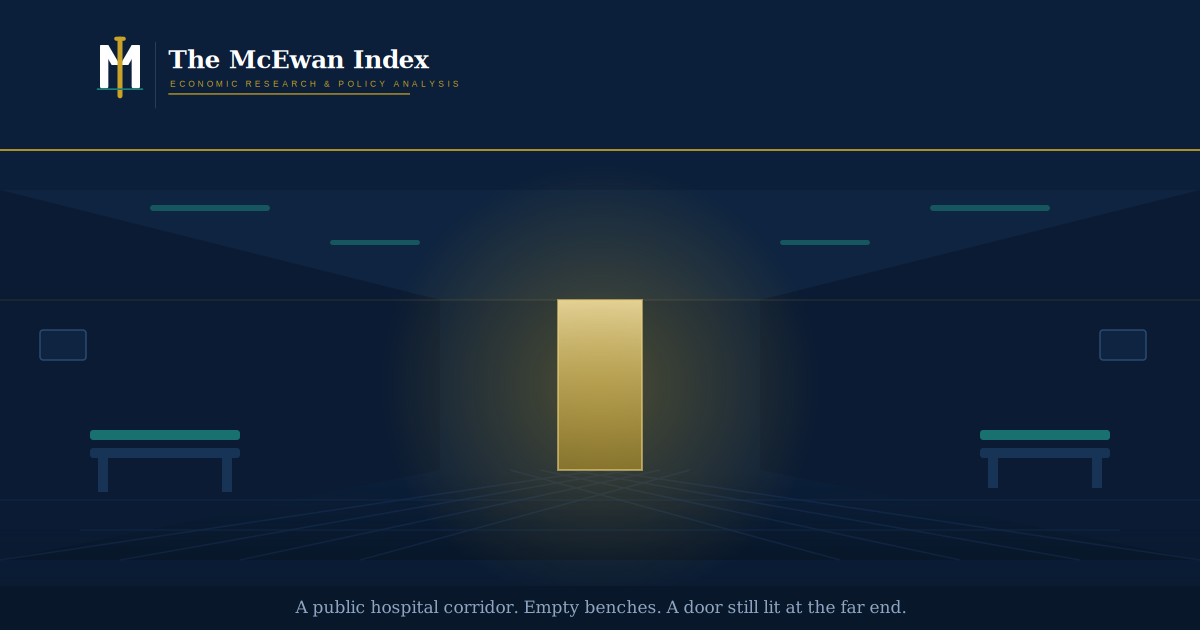
Imagine a woman lying in a hospital bed for twelve days, telling anyone who will listen that something inside her is not moving the way it should. Imagine her calling a relative from a ward phone because there is no ambulance to take her for a scan the hospital itself has recommended. Imagine being told, essentially, to manage the problem herself.
This is not a report of a specific person's private medical record. It is a composite of the kind of account that has become painfully familiar to Jamaicans in 2026, the kind of account that circulates on WhatsApp and radio call-in shows long before it appears in an official statement. It is the texture of what it can feel like to be a patient inside a system that is, on paper, more resourced and more qualified than it has ever been.
The Ministry of Health and Wellness says it has received more than 1,000 patient complaints through its Client Care Connect mechanism, and that the complaints cluster around three things: communication, professional conduct and the overall patient experience. In September, the ministry plans to publish accountability data naming the institutions, departments and, implicitly, the individuals connected to the worst outcomes. Portfolio minister Dr Christopher Tufton has framed this as a shift from generalised complaint to specific responsibility, from blaming an entire workforce to identifying where, precisely, care breaks down.
That is a defensible instinct. It is also not the whole story, and Tufton, to his credit, has said almost as much himself. Speaking of the case that has done more than any statistic to concentrate public attention on this issue, the death of 33-year-old Kenise Dunn five days after delivering her third child at St Ann's Bay Regional Hospital, the minister offered a sentence that deserves to be sat with rather than skimmed past: the clinical diagnosis, he said, appeared to have been correct, but the management of care and the empathy shown to the patient may have fallen short.
The diagnosis was right. The patient still felt abandoned.
That single admission contains the entire argument this essay wants to make. Jamaica does not primarily have a crisis of medical knowledge. It has, in places, a crisis of what happens between the knowledge and the person who needs it applied to them with patience, clarity and respect.
What care actually means
There is a quiet assumption buried in how societies talk about health systems: that care is essentially a technical transaction. A patient presents. A professional diagnoses. A treatment is administered. If the treatment is correct, the encounter is judged a success, regardless of how it felt to live through.
The complaints reaching Client Care Connect suggest ordinary Jamaicans reject that assumption, whether or not they would put it in those words. They are not, in the main, alleging misdiagnosis. They are describing a different failure: being spoken to dismissively, not being told why a procedure was delayed, not knowing who was responsible for their care, waiting without explanation, feeling like a file rather than a person.
None of that is peripheral to medicine. Being informed, being addressed with respect, having a clear sense of who is accountable for you and being spoken to in a moment of fear are not courtesies layered on top of clinical care. They are conditions under which clinical care actually works. A frightened patient who does not trust the people around her is a patient less likely to disclose symptoms accurately, less likely to follow instructions, and more likely to leave against advice or default on follow-up. The evidence base on patient experience, built over decades by health services researchers internationally, points consistently in one direction: how a patient is treated interpersonally is not separable from clinical outcome. It is part of it.
The number, and what it does not tell us
More than 1,000 complaints is a serious figure and deserves to be treated as one. It should not, however, be treated as self-explanatory.
A complaint count rising is compatible with at least two very different stories. It could mean that care is deteriorating. It could also mean that Client Care Connect has finally given Jamaicans a channel through which grievances that once went nowhere are now being recorded. Both things can be true, and probably are, to varying degrees, in different facilities.
What the public record does not yet show is more instructive than what it does. We do not know, from anything published so far, which facilities or departments generate a disproportionate share of complaints. We do not know the median time between a complaint being lodged and a complainant receiving a substantive response. We do not know how many complaints are investigated and substantiated, how many result in disciplinary or corrective action, and how many complainants are ever told what happened as a result of speaking up.
These are not rhetorical gaps. They are the difference between an accountability system and an accountability announcement. Jamaica should treat them as an unfinished checklist rather than settled questions, and the September publication is the moment to see whether the ministry intends to close them.
Accountability, and the line before scapegoating
Tufton's language has been unambiguous. He wants names, departments, institutions. He has explicitly rejected the idea of a single bad actor tarnishing an entire workforce, insisting instead that failure be traced to where it actually occurred.
There is something to admire in that precision. Vague institutional shame, the kind that lands on every nurse and doctor regardless of their individual conduct, is neither fair nor useful. It punishes the many for the few and gives management nothing concrete to fix.
But precision about where a failure occurred is not the same as precision about why it occurred, and that second question is where this initiative will be tested. A nurse who is rude to a patient during a two-minute interaction has committed a conduct failure that is hers to own. A nurse who has been on a ward with half the staffing a shift requires, who has not had a proper meal break in nine hours, who is managing more acute patients than any single person reasonably can, and who is short with a family member at hour ten of a double shift, is operating inside a structural failure that predates her and will outlast her removal from post.
Treating both cases identically, as if discipline alone resolves them, would be a mistake dressed up as rigour. It would also be popular, because naming and removing individuals photographs well and satisfies an understandable public appetite for someone to answer for suffering. Whether it fixes anything is a separate question, and it is the one Jamaica's accountability framework has to answer honestly rather than performatively.
The distinction that matters is between misconduct, which is a matter of individual choice and should carry individual consequence, and system failure, which is a matter of staffing, supervision, workload and design, and which individual discipline cannot solve. A serious accountability regime holds both categories to account, but it does not confuse punishing the second for solving the first.
What Jamaican health workers are carrying
It would be dishonest to build an essay about patient dignity without asking what is happening to the people delivering care, because a system that grinds down its workforce eventually grinds down its patients too.
Jamaica has for years lost a meaningful share of its trained nursing workforce to migration, particularly among specialist nurses in areas such as operating theatre, oncology, neonatal and renal care, where the shortage is most acute. The ministry itself has acknowledged losing roughly 500 specialist nurses annually to migration in recent years, a hole that domestic training programmes cannot close quickly, since it takes years to produce a nurse and months for one to leave. The government's own diaspora recruitment drives, and a career fair that reportedly screened close to 3,000 applicants against several hundred vacancies, are not signs of a system relaxed about its staffing. They are signs of a system trying, visibly and urgently, to fill gaps it knows are there.
This context does not excuse cruelty or negligence toward a patient. It does explain, in part, why a technically excellent workforce can still produce a thousand complaints about how people were treated. Exhaustion narrows a person's capacity for patience. Understaffing turns communication, the very thing patients are complaining about the absence of, into the first casualty of an impossible shift, because explaining things to a frightened family takes time that an overstretched ward does not have.
Protecting patients and protecting health workers are not opposing projects. They are the same project, viewed from two ends of the same corridor.
The economics that hide behind a waiting room
An economist looking at this story sees more than a governance problem. Poor patient experience carries a cost that rarely appears on any ministry balance sheet but is real all the same.
A patient who does not understand her discharge instructions is more likely to return, consuming resources twice for a problem that competent communication could have resolved once. A family that loses confidence in a public facility may pay out of pocket for private care it cannot comfortably afford, a transfer of cost from the state to the household that does not show up in any public accounts but shows up in a family's bank balance. Staff turnover, driven partly by burnout in poorly managed departments, carries its own direct cost in recruitment and training, and an indirect cost in the loss of institutional memory each departure represents.
Then there is the cost of time itself, distributed with brutal unevenness. A three-hour wait means something different to a salaried professional with paid leave than it does to a self-employed higgler who earns nothing while she is not selling, or a taxi driver whose car sits idle, or a daily-paid construction worker docked for the hours he is not on site. For rural patients, a hospital visit often means a bus fare, a lost day, sometimes an overnight stay with relatives near the facility. None of this appears in a complaint about "poor communication." All of it is the lived cost of a system that does not tell people, promptly and clearly, what is happening to them and why.
Trust has an economic value too, even if it resists a clean unit of measurement. A citizen who believes the public health system will treat her with basic respect is more likely to seek care early, when problems are cheaper to treat, rather than delaying until a condition becomes an emergency. A citizen who has been humiliated once is a citizen who may avoid the system until it is almost too late. Dignity, in that sense, is not a soft add-on to health policy. It is a determinant of when people show up.
Governance is the word that matters most
The temptation in a moment like this is to make the story about attitude: workers who care versus workers who do not. That framing is emotionally satisfying and analytically thin.
The better question is one of governance. Are hospital managers evaluated, in any real and consequential way, on how patients are treated in their departments, or only on throughput and clinical indicators? When a complaint is substantiated, does a documented corrective action follow, or does the file close with a note and nothing more? Are recurring failures in a specific ward tracked over time, so a pattern is visible before it produces a tragedy, or does each complaint arrive and depart in isolation? Do the people running facilities have the authority and the resources to actually fix what a complaint reveals, or are they, too, hostages to a staffing and budget decision made somewhere far above them?
Accountability without architecture is a speech. Real accountability requires a sequence: something is measured, someone is responsible for it, a problem triggers an intervention, the intervention is followed up, and a consequence, positive or corrective, eventually attaches to the outcome. Naming a department where failure occurred is the first link in that chain. It is not the chain.
What September should actually show
The ministry has committed to publishing accountability data next month. That publication is a genuine opportunity, and Jamaica should hold it to a meaningful standard rather than accept whatever version arrives.
Useful data would go beyond a raw complaint count. It would show, at the level of individual facilities and departments, the categories complaints fall into, how quickly they are acknowledged and resolved, what share are substantiated after investigation, what corrective action follows a substantiated complaint, and whether the same unit generates repeat complaints over time, which is often a stronger signal of a systemic problem than any single incident.
There is a line worth drawing here, and it matters. Transparency that helps citizens understand where problems concentrate, and helps managers see patterns they might otherwise miss, is a public good. Data released mainly to generate outrage against named individuals, without due process, without distinguishing an isolated lapse from a demonstrated pattern, risks becoming punishment theatre rather than reform. Jamaica can want both accountability and fairness. The design of what gets published in September will show which one the ministry is actually building toward.
The patient walks in with nothing but trust
Strip away the policy language and what remains is simpler and harder to look at directly.
A person who enters a public hospital in Jamaica is, in that moment, almost entirely without power. She does not choose her doctor. She often does not fully understand the terminology used around her. She may not know what she is entitled to ask for, or whether asking will be held against her. She is, by definition, more vulnerable than the people responsible for her care, and that asymmetry is precisely why the encounter carries moral weight beyond the clinical.
Dignity, in that setting, is not an optional grace note. It is a recognition of power, and of the obligation power creates. An institution that understands this treats a patient's fear as something to be addressed, not managed around. An institution that does not treats a patient as a case to be processed, however technically well the processing is done.
Whether that recognition depends partly on who the patient is, her income, her education, her ability to advocate confidently for herself, is a question Jamaica has not sufficiently measured. It is a fair suspicion. It should be treated as a research gap to close rather than an assumption to assert.
There is also an uncomfortable comparison sitting just beneath the surface of this conversation, between public and private care. Jamaicans who can afford it often describe private facilities as more responsive, and the reasons offered range from shorter queues to different staffing ratios to a customer-service culture built around paying clients. Whatever the precise mix of causes, the deeper point is philosophical rather than economic. Dignity is not supposed to be a product a citizen purchases when the public system fails her. A country's health system should not require a private insurance card as the entry fee for being spoken to with respect.
Every hospital bed is also a conversation with the state
There is a final layer to this that has nothing to do with medicine and everything to do with government.
A public hospital is, for many Jamaicans, one of the most direct and vulnerable points of contact they will ever have with the state. It is not an abstraction like a policy document or a budget line. It is a building they enter frightened, staffed by people paid with their taxes, operating under rules set by a ministry they did not choose. When that encounter goes badly, the citizen rarely files the experience away as a complaint about one nurse or one doctor. She files it as evidence about what her government actually is, underneath its speeches.
That is why this issue reaches further than health policy. Every well-handled encounter is a small deposit of trust in public institutions generally. Every badly handled one is a withdrawal, and withdrawals compound.
What a serious reform agenda looks like
None of the above should read as an argument against the ministry's push for accountability. It should read as an argument for building that push properly, with tools equal to the ambition behind it.
A meaningful accountability framework would publish facility-level patient-experience data alongside clinical indicators, not as a separate afterthought but as a core measure of institutional performance. It would set clear timelines for acknowledging and resolving complaints, timelines patients are actually told about, so that silence stops being the default response to a grievance. It would require a documented corrective-action plan for every substantiated complaint, reviewed for whether it was actually implemented rather than merely filed. It would extend managerial accountability upward, evaluating hospital and departmental leadership partly on patient experience outcomes, not only on throughput. It would protect staff who report unsafe conditions or unsafe staffing levels in good faith, since punishing the messenger guarantees the next problem stays hidden until it becomes a headline. It would invest directly in frontline staffing and in the working conditions that make patience and communication possible during a shift, because empathy is difficult to sustain in an environment engineered to exhaust it. It would train managers, not only frontline staff, in patient experience, since a ward's culture is set from above far more than any single orientation session for nurses can correct. And it would build a stronger, independent channel for patient advocacy, so a family navigating a crisis has somewhere to turn that is not simply the same institution being asked to investigate itself.
Each of these carries a risk worth naming honestly. Publishing facility data can, if handled carelessly, turn into public shaming of understaffed institutions for failures their own managers lack the resources to fix. Protecting whistleblowers requires genuine institutional will, not just a policy on paper, or it becomes a promise nobody trusts enough to rely on. None of these reforms is a guarantee. They are a direction, and Jamaica has not, on the evidence so far, fully committed to walking it.
The question underneath the question
The debate Jamaica is currently having sounds like a debate about negligent health workers. It is really a debate about what kind of public institutions this country intends to build.
Institutions that process people, or institutions that serve them. Institutions that defend themselves the moment a citizen complains, or institutions capable of actually listening. Institutions that count how many procedures were performed, or institutions that also ask whether the person on the table understood what was happening to her, and felt like a human being while it happened.
Kenise Dunn's family is still waiting for a full accounting of her final twelve days. Whatever that investigation ultimately finds, the minister's own words about her case have already said something larger than any single finding could. The diagnosis, he said, appeared to have been correct.
It usually is. That was never really the problem.
The problem is what a country decides to do about all the moments in between the diagnosis and the discharge, the moments where a frightened person is waiting for someone to explain, to listen, to treat her time and her fear as though they matter. Jamaica's hospitals are, in the main, staffed by people who know their medicine. What the next set of reforms will actually test is something else: whether every Jamaican who walks through those doors can leave knowing that their life, their time, and their dignity mattered to the system charged with protecting all three.
That is not a question a September data release can answer by itself. It is a question this country will keep answering, one patient at a time, for as long as it refuses to ask it seriously.